
Competition Is a Symptom, Not a Strategy
- BY
- ROOT TEAM
- PUBLISHED
- SEPTEMBER 21, 2026
- READING TIME
- 12 MIN READ
Peter Thiel spent an hour of Stanford's startup course explaining why competition is for losers. Most people remember the provocation. Few notice the diagnosis underneath it — competing is the symptom, and the cause is building in a game where a fight was the only possible outcome.
In the spring of 2000, Peter Thiel's company was at war with Elon Musk's. PayPal and X.com shipped the same product, worked out of the same office building in Palo Alto, and the two halves of what was supposed to be one merged team screamed at each other in the hallways. Thiel still tells this story like it embarrasses him. The detail that always lands is Christmas: people worked the holiday because everyone was certain the company would be gone before January.
PayPal won that war. It beat the only competitor that mattered, absorbed it, and came out owning most of its small corner of online payments. And his honest verdict, delivered years later, is that winning is not what saved the company. The market they won was tiny. The victory was worth almost nothing by itself. What kept PayPal alive was that it had spent a brief moment solving a problem nobody else had solved — and it had to last long enough for that value to arrive.
Thiel tells this story at the start of a 2014 Stanford lecture called Competition Is for Losers, the fifth class in Sam Altman's how-to-start-a-startup course. The title exists to offend fifty years of business-school instincts, and it works. But underneath the provocation is a structural argument most founders never get near: if you are fighting, you have already picked the losing game.
Capitalism and competition are antonyms
The lecture opens with "capitalism and competition are antonyms," which sounds like a man trying to agitate on purpose. He is. He is also being literal.
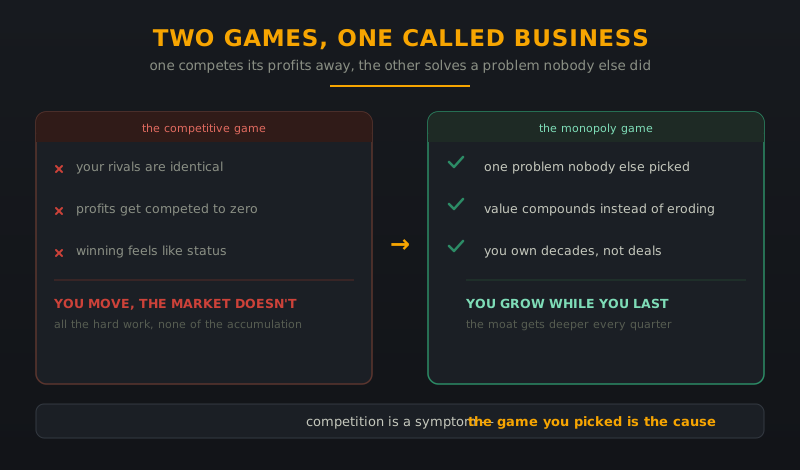
Capitalism means accumulating capital. Competition means eroding it. In a perfectly competitive market — many sellers, identical products, no differentiation, free entry — the market competes every surplus away until nobody earns a meaningful return. That is the textbook definition, and Thiel's point is that the textbook is describing a machine built to destroy profits. Things get cheaper and better for everyone while the people who make them starve. Why would you spend your working life inside a machine that guarantees zero economic profit?
Then he flips the moral polarity. We are trained to admire the competitor — the scrappy little shop fighting the giant. Thiel says the scrappy shop is not admirable, it's confused. Its owner grinds in a market that can only ever hand him a wage. And the monopolist, the word we were raised to hear as "villain," is the one who built something singular enough that no one can erode it. Competition is not the healthy condition of business. It's the sign that you spent your effort where the rules of the game were already set against you.
That is a root-cause argument wearing a controversy. The symptom is a culture of warfare. The cause is choosing to build where a fight was the only possible outcome.
The restaurant test
His go-to example is restaurants, and it is the most useful parable in the lecture.
The advice founders hear most often is "pick a big market." The restaurant industry is one of the biggest there is. By its own logic, restaurants should be the best business in the country. They are famously the worst — and the bigness is the reason. More market means more rivals, less differentiation, more perfect competition, more certainty that every profit gets competed away. Big markets aren't prizes. They're crowds.
Thiel calls this advice "utterly and totally wrong," and it is worth sitting with how counterintuitive that is. He paints the restaurant in its normal operation: the family at the register, the kids washing dishes, everyone working flat out to generate a small and fragile income — income a food truck can eat just by parking in front of the door. The enormous industry does not help the individual restaurant. It guarantees the restaurant can't stand out.
The naming game
This is where a founder can quietly trick themselves, and it is the sharpest diagnostic in the whole talk.
There is no other British food restaurant in Palo Alto. Get tighter — British food, in Palo Alto, under twenty-five dollars — and yours is the only one on Earth. The categories intersect so precisely that you can claim absolute uniqueness.
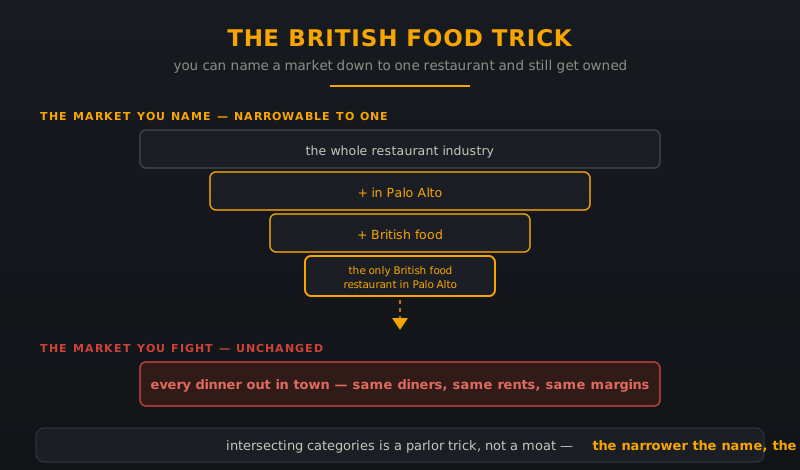
And it means nothing. The truck that parks outside your door isn't British. It doesn't have to be. It wants the same five customers you want. The market you actually fight is never the intersection of the adjectives you invented; it is every alternative your customer is weighing. A "monopoly" that needs a comma list to exist is a bedtime story you tell yourself at the board meeting.
So: distinguish the market you name from the market you fight. If your uniqueness only survives a narrowing chain of adjectives, you aren't a monopolist. You're a liar with a chart.
Everyone lies about competition
The confusion persists because there is an incentive to lie, and both sides use it.
Real monopolists deny it. The successful ones have every reason to insist they are one click away from disaster — it keeps regulators, the press, and the copycats at arm's length. People in genuinely competitive markets insist the opposite: that they are one product away from owning everything. That is what "we're about to disrupt the industry" is for. Anyone can say either sentence. The trick is that the incentive to say it is strongest when it isn't true.
Thiel's advice is to invert the claim and believe the inverse. A company that insists it's drowning in competition is usually protecting a niche where it quietly earns everything. A company that insists the field is wide open is usually trying not to notice the field closing. You can't audit a business from its own marketing copy, but you can at least refuse to trust it.
What a real monopoly is made of
He lists four ingredients, and it's the part of the lecture that ages well. Memorize it.
Proprietary technology, at minimum 10x better than the best alternative. You cannot persuade a user to switch for 10% improvement; that's a rounding error. 10x is a new category, and categories are hard to contest.
Network effects. Every user makes the thing more valuable to every other user, so the product improves as it's used — faster than any rival can imitate the improvement.
Economies of scale. Fixed costs spread across a growing base until marginal cost per user approaches zero. This is software's whole secret, and why software ate the world.
Brand. A durable, hard-to-copy trust that keeps you at the front of the mind and out of the crosshairs.
Then the twist. Each of these carries a time dimension, and Thiel's timing argument is what made this lecture prescient. Silicon Valley worships the first mover. Thiel says the first mover usually educates the market and dies teaching it — the value of being early is wasted if you don't survive. He runs PayPal's own numbers: a company growing a hundred percent a year still carried most of its worth beyond the horizon it could see. The last mover — the company still standing when a category finishes consolidating — is the one who collects. Microsoft was the last operating system for decades. Google is the last search engine. Facebook is valuable precisely because it might be the last social network.
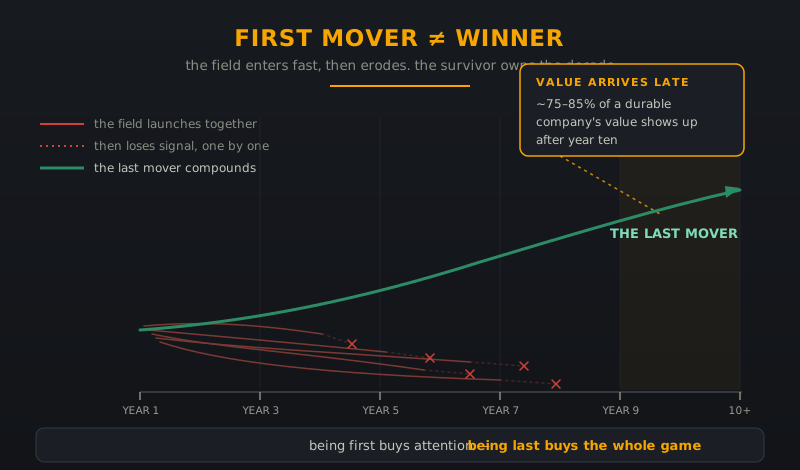
Being first wins attention. Being last wins the market.
Why we compete anyway
Then comes the part of the talk that is genuinely human, and the reason this hour still gets quoted a decade later. If competition is a losing game, why does everyone keep choosing it?
Thiel's answer isn't economic. It's psychological.
Competition is validation. It is easier to beat the person beside you than to answer the question nobody asked. A market with rivals feels real — rivals prove the game matters, that you aren't a fool building for nobody. So we herd into crowded fields because they are the only fields where losing feels normal and winning feels like approval. He is describing the startup scene, the sports field, the school — anywhere status is decided by beating the person next to you. Chosen for the validation. Suffered for the margins.
That is the actual root cause, and it never shows up in a market analysis. We don't compete because it's profitable. We compete because it's confirming.
A race you can't win by running
Watch the shape of that last paragraph. It's the same shape we run on any failing system.
The symptom is reported loudly: the market is crowded, the rivals are relentless, the war is brutal. Everyone treats it as a competitive problem and responds with competitive solutions — ship faster, hire better, spend more. But the trace doesn't stop there. It keeps digging, and at the bottom it finds the game itself was chosen wrong.
Symptom:   "we keep losing to the competition"
     why
Surface:   rivals out-ship us, quarter after quarter
     why
Layer 2:   we are building the same product, only faster
     why
Origin:    we entered a game instead of solving a problem
Out-shipping your rival does not fix this. It accelerates it. You cannot win the race by running harder when the race is the problem.
The cheap way to test which game you're in
You don't need a market report to find out. You need four honest answers.
- Say the problem without naming your competitors. If your pitch only makes sense relative to someone else's product, you're a derivative, and derivatives get competed away.
- Ask what happens if you disappear. If nobody notices, you aren't creating value, you're occupying a slot in a market. Slots can always be refilled.
- Draw the value timeline. When does the money come: year two or year twelve? If everything is near-term, you're extractive, not durable — and the last mover collects at year ten.
- Count the adjectives it takes to make your market unique. One is a claim. Two is a stretch. Three and you're the British food restaurant in Palo Alto.
There's one more piece of advice in the lecture that repays attention, and it's the least quotable: start small. Own the smallest market you can name — PayPal started with eBay power sellers, Facebook with one campus, Amazon with books, Google with search when it looked finished. Dominate the small game first; the expansion follows along a vector, not by scattering into a bigger crowd. Thiel's line is that you want to be the last mover, not the first. The way to be last is to pick a small game, take it, and then refuse to leave.
What we did with this lecture
We built ROOT on the opposite of the competitive reflex, and this lecture is the closest thing we've seen to a statement of why.
FleetOS didn't start with a market-size slide. It started with a problem nobody at a crowded spreadsheet-competitor was willing to hold: fleet operators lose money to invisible faults, so it traces them to the cause. Zyren started with the creator making videos on a schedule that destroys them, not with the AI-automation category. The eligibility work started with "policy, as code — a checked, provable statement," which isn't a category, it's an answer to a question nobody else thought to ask.
None of these are monopolies in the anti-trust sense, and that's not the point. The point is the same refusal: we would rather be the last ones in a small game we understand than the hundredth ones in a big one we're renting. When someone asks us "aren't your markets small?" the honest answer is yes — and small is exactly where competition can't reach us. When someone asks "aren't there competitors?" the honest answer is that competition is a symptom, and we'd rather spend our days on the cause.
Go watch the hour
The lecture holds up. Watch it for the restaurant, for the Christmas story, for Thiel explaining that a man will suggest merging your startups at gunpoint — most of what made it famous is still exactly as uncomfortable as billed. But hold on to the one-liner everything else is built on: if you are in a fight, you picked the wrong game.
Competition is a symptom. The root cause is choosing to build where a fight is the only possible outcome. Find the cause, then build. The fights you avoid are the ones you win.
Related reading: Root Cause Thinking for the discipline this argument runs on, and When AI Became a Commodity, the Moat Moved for a recent example of a moat that had to move. The original talk: How to Start a Startup, Lecture 5 — Peter Thiel.