
Your Value Prop Is a Root Cause, Not a Pitch
- BY
- ROOT TEAM
- PUBLISHED
- SEPTEMBER 22, 2026
- READING TIME
- 13 MIN READ
The top reason companies fail is not execution or fundraising or timing. It's that the problem they picked isn't valuable enough for anyone to change their behavior for it. Michael Skok's Harvard workshop is the clearest method we have seen for finding that out before you build.
A friend of ours keeps a folder of ideas. It is a beautiful document — every page a product, a market, a wedge, a roadmap. He has pitched most of them. He has sold none of them. When someone finally asked what problem the newest idea solved, he paused and answered in features: a dashboard, an integration, a "real gap in the market." The problem should have been the easiest sentence in the room. It was the only one he could not say.
That folder is a museum of the number one reason companies fail. And it is not the reason most founders blame.
The reason companies fail
Michael Skok has spent a total of forty years split between building companies and funding them — twenty-one as an entrepreneur, eighteen on the venture side with Underscore VC — and more than a decade teaching at Harvard, where he built the Startup Secrets series at the Harvard Innovation Labs. In his workshop _Value Props: Create a Product People Will Actually Buy_, he opens with the uncomfortable version of startup history:
The number one reason that companies fail is because they're not solving a valuable enough problem.
Not execution. Not fundraising. Not timing or team or the market being "cold." Problem selection — the choice of which wound to work on — is where companies die, and they usually die there quietly, months before the missed revenue becomes obvious. The rest of the hour is a method for making that one choice a discipline instead of a vibe. It runs in three passes — define, evaluate, build — and the whole point is that they happen before the code, not after the pitch deck.
This is a root-cause argument wearing a marketing course. The symptom is a product nobody buys. The cause sits upstream, in a problem that was never painful enough to interrupt anyone's week. Everything you will touch next — the deck, the pricing page, the ads, the onboarding — is downstream of that one decision. Marketing is a multiplier. Multiply zero and you get zero.
Ideas are two a penny
Skok's first provocation is aimed straight at the idea-catalog. "Ideas are two a penny," he says. They do not have meaning until they attach to a problem or an opportunity.
Read your own folder again with that filter and it changes shape. A good idea is not a market; it is a compliment. Someone always likes your idea. That is social approval, and social approval is not a willingness to switch. The value proposition is the place where idea meets pain — the benefit you provide, to whom, and how you do it uniquely well. If the problem is not painful enough, the best engineering you own becomes wasted motion: a beautiful solution to a problem the customer keeps postponing.
For whom, exactly
The first pass of the workshop is define, and it starts with a question almost every pitch skips: for whom?
The trap is "everyone." Skok is blunt about where that road ends:
If you don't know who your customer is and you think it's everybody, you're going to fail by default.
Everyone is not a market. It is a way to avoid choosing. His tool for the job is the minimum viable segment — the MVP's quiet cousin. A narrow group with uniform needs, small enough to reach, specific enough to build for. The workshop's example is a non-profit bridging Kazakhstan's digital divide, whose value prop is not "children in Kazakhstan" but children in marginalized and rural communities who lack basic digital literacy and equipment. That sentence is an address, not a noun. It tells you who, where, and what is missing.
There is a second question underneath it, and it is the one that quietly kills SaaS: who pays versus who uses? When the person paying is not the person benefiting, you write two value propositions. The user needs enough value to adopt; the customer needs enough value to pay. Satisfy only the buyer and adoption stalls. Satisfy only the user and the invoices stop. Skok says the user has to feel the value or nothing else survives — the product is only proof once somebody inside the customer's company is fighting for its renewal.
The definition pass ends in a sentence you can actually grade. Skok's recipe:
_Unlike_ the unworkable alternative, _for_ the target segment — dissatisfied with the existing solution _because of_ an unmet need — our product _offers_ a category that _provides_ these key benefits.
Write that sentence for your product. If the second clause is vague, your problem is not your pitch. It is that you never defined who is hurting or how.
Does the problem actually hurt?
The evaluate pass is where the discipline begins. Almost nobody runs it, because it forces you to stop talking about your solution and go back to the problem with a checklist. Skok's checklist is the four U's, and he introduces it with a line worth taping to a monitor: "a problem well stated is half solved."
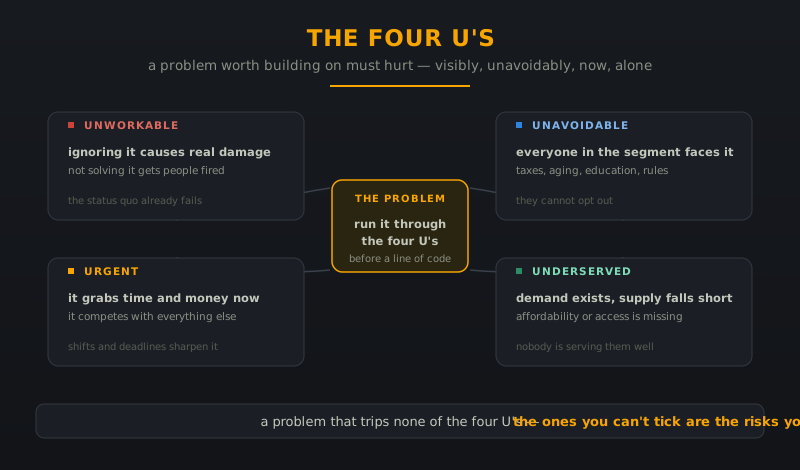
A problem worth building on must light up at least one of these:
Unworkable. Ignoring it causes real, measurable damage. In Skok's words these problems get people fired — they are that painful. When the status quo is already failing, you are not asking a customer to try something new, you are offering a way out. Asking for adoption is easier when the alternative is losing the job.
Unavoidable. Everyone in the segment has to face it. Taxes and death, he reminds every room — usefully for his point, both are inescapable. Aged parents, required compliance, mandatory education. The customer cannot decline the problem, only the way they currently handle it.
Urgent. This one is relative, and people miss it constantly. A problem is urgent when it competes successfully for time and money _right now_ — against the customer's other top priorities, not against your slideware. Market shifts are urgency factories: mobile was one, AI is one now. What was a nice-to-have yesterday became a must-handle last quarter, and the founders who saw the shift landed on the right side of the urgency curve. The uncomfortable corollary: if the problem is not urgent to _this_ segment, you do not get to argue it is urgent to someone else. Go find the segment where it is.
Underserved. Demand exists, but supply is missing on affordability or access. Skok's example is a venture around Kenyan coffee — the product customers wanted was unavailable from their own market and too expensive to buy otherwise. Demand + no supply + a gap someone else filled by charging too much. He also points at startups serving menopausal women: an unavoidable biological stage, widely ignored, deeply underserved. When demand exists and nobody serves it well, the four U's write themselves.
Run every idea through the test. An idea that trips none of the four U's is a hobby with a logo — it will consume your best years and then someone will ask what problem it solves, and you will answer in features. Skok's own scale adds a sour note here: the worst problems are _latent_ and _aspirational_, felt by nobody until you explain them. The best are blatant and critical, felt before you arrive. The whole game is moving from "nice to have" to "must have," and the four U's are the from/to.
Build the breakthrough, not the improvement
The build pass begins with the most dangerous sentence in a founder's vocabulary: _faster, better, cheaper._
It sounds like a value proposition. It is a surrender. Big competitors have more resources than you, and they will spend them on exactly that race — out-speeding you, out-featuring you, out-pricing you. Faster, better, cheaper is a ladder the incumbent climbs with money. You will climb it until your runway ends.
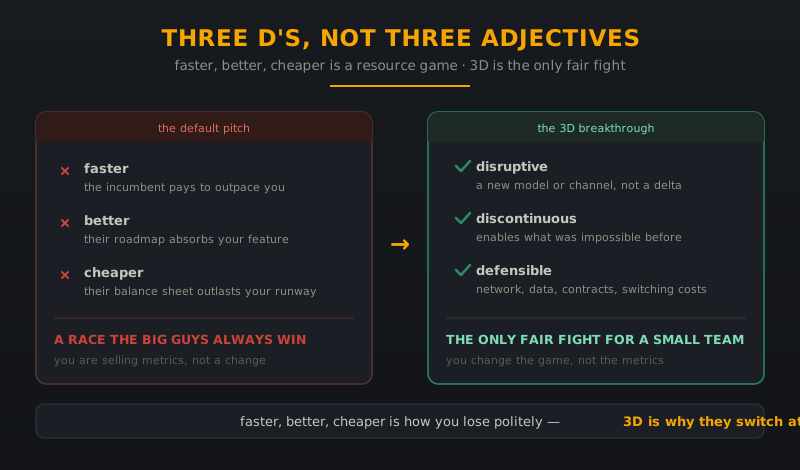
Skok's answer is the 3D breakthrough, and it is the closest thing the workshop has to a formula:
Disruptive — a different model, not a marginally better version of the same one. Skok's example is Airbnb: it invented almost nothing, changed the way existing, unused resources get connected, and the travel industry rearranged itself around the result.
Discontinuous — something you literally could not do before your product existed. AWS is the canonical case: cloud computing invented a category out of impossibility, then let an entire economy of businesses build on top of it.
Defensible — the moat. Intellectual property, network effects, switching costs, proprietary data, long contracts. Skok tells the story of a coffee venture defending itself with ten-year farmer contracts, locking the supply chain before anyone else could sign it; and the compact with data: every user makes the model stronger, and stronger makes it harder to leave.
The 3D test is unforgiving, and it should be. It is the reason this part of the workshop matters: a small team's only fair fight is one where the incumbent's advantages — budget, talent, distribution — do not apply. Change the game and their resources stop being weapons.
There is a related lesson in the workshop about platforms, and it is one we feel deeply. Skok walks through the iPad — which launched as a nice-to-have and became a must-have _in specific jobs_ — and the watch wars, where the product that won was the one with the ecosystem. Jobs did not predict every application; he built a surface other people could build on, and let them fill the value. Skok's blunt version: your product is very unlikely to be the whole solution a customer has. Design for the dependencies, build the platform, let users and partners complete the chain — or live with an offering that solves a corner and not the job.
Evaluate the exchange
The final pass is a brutal accounting. Everything above produced a promise; now price it against friction.
The gain–pain ratio is the scoreboard: the gain you deliver versus the pain of adopting — money, time, risk, and the sheer annoyance of switching. Skok's bar for a real product is a multiple, on the order of ten times. A 20% improvement is a rounding error; people do not switch for rounding errors, they switch for a different life.
He matches it with inertia and risk. The question riding in every customer's head, unasked, is the one he quotes: "What happens if I put my money in this network and this startup fails?" Every new vendor is a bet the customer may not want to place. If you cannot answer the switcher's fear — with guarantees, with migration paths, with proof the thing works before they commit — you have a value proposition and no way to cash it.
And beneath all of it, one question decides sustainability: what is life before your product, and what is it after? If the "after" is not quantifiably better and the model cannot pay for the "before" to become the "after," then even a true problem is not a business yet.
Why this is a root cause problem
Here is the uncomfortable conclusion, and it is the whole reason we are writing about a business workshop on a site about software.
A value proposition is not copy. It is the root cause of whether a product gets bought. The deck that reads beautifully, the pricing page that converts at industry average, the ad that finally gets clicked — all of them fail in a deterministic chain when the value prop underneath is weak. You can polish the symptom forever and it will keep not working, because it was never the load-bearing part. The proof is that most of the "marketing problems" we get described turn out, on one conversation, to be a problem-selection problem someone has not yet admitted to.
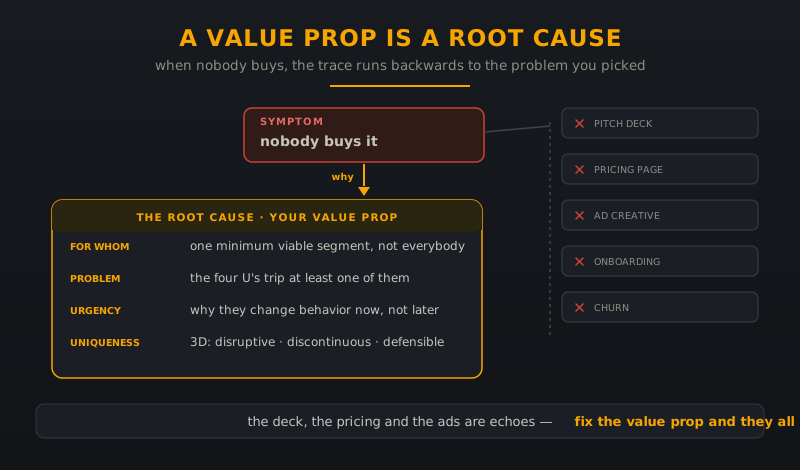
We built a studio on the opposite of that trace, and it has quietly kept us honest. FleetOS didn't start with a fleet-management category; it started with operators losing money to invisible faults — unworkable, urgent, and entirely unserved at small-operations prices. Zyren started with a creator whose posting schedule was destroying them, not with the AI-automation market. The eligibility work started with an unavoidable grievance — compliance that had to be provable, traceable, and argued about endlessly — and answered it with "policy, as code." In every case, the value prop was the first thing we wrote and the thing we kept testing. The product was how we cashed it.
Skok ends the workshop with a question that should be load-bearing at every kickoff: if you don't uniquely understand the problem you're addressing, then why are you doing it? It is the sharpest one-sentence filter we know, and it refuses the folder. Understanding the problem is the actual work. The idea was never the scarce resource.
Try it this week
- Write the sentence. Fill in Skok's recipe for your product — _unlike_ the current alternative, _for_ this segment, dissatisfied _because_ of this unmet need, we offer a category that provides these benefits. If any clause is vague, that clause is your problem.
- Run the four U's. Unworkable, unavoidable, urgent, underserved. Count the ticks honestly. An idea with zero ticks is a hobby.
- Ask five real users the one question the pitch never asks: what happens if you do not fix this? People who answer with a consequence are your market. People who answer "nothing, really" have given you your answer.
- Delete the adjectives. Take _faster, better, cheaper_ out of your deck and see what the product is still standing on. If nothing is left, you were selling metrics, not a change.
Go watch the hour
The workshop is free on YouTube, recorded at Harvard Innovation Labs and worth a whiteboard. Watch it for the four U's, for the 3D breakthrough, for Skok explaining to a room of founders that their problems are too comfortable — but hold on to the one line everything else hangs from: you are not failing to execute; you are failing to pick a problem people can't ignore.
Related reading: Root Cause Thinking for the discipline this runs on, Competition Is a Symptom, Not a Strategy for what happens when founders solve the wrong game, and Your Pricing Page Is a Symptom for the downstream version of the same trace.