
Root Cause Thinking: Why We Build From First Principles
- BY
- ROOT TEAM
- PUBLISHED
- AUGUST 17, 2026
- READING TIME
- 4 MIN READ
Most software treats symptoms. Here is the process we use at ROOT to dig past what is broken and find what is actually missing.
Every product we've shipped started the same way. Someone on the team hit a problem, looked for a tool to solve it, and found every option treated a symptom instead of the cause.
Fleet management tools showed where trucks were, but not why routes kept failing. Developer dashboards counted deploys, but not whether engineers were burning out making them. The market had dashboards. It didn't have understanding.
The five whys, applied to software
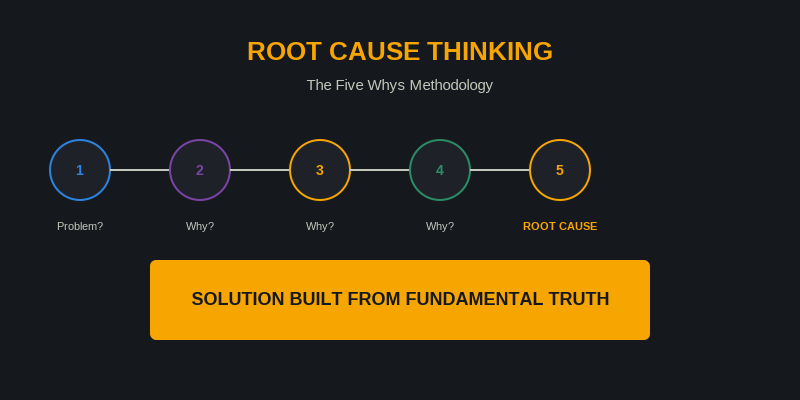
Borrowed from manufacturing, the five whys is simple. When you find a problem, ask why it exists. Then ask why again. Repeat until you hit something fundamental. We published a full guide to running this loop, with a comparison to fishbone and FMEA and a free tracer you can run your own problem through. This post is about what it looks like when we apply it to products.
For FleetOS, the chain looked like this. Deliveries are late because routes are inefficient. Routes are inefficient because they're planned on stale data. The data is stale because dispatch runs on spreadsheets updated once a day. That happens because nobody built dispatch tooling for small fleets, only for enterprise giants.
That last sentence is the root cause. Everything in FleetOS flows from solving it.
The same chain, three more times
The pattern repeats across every product we've built, which is the strongest argument that the method works. Here are the other three chains, written the same way.
Zyren exists because of a chain that starts with posts underperforming. Posts underperform because they're scheduled by editorial habit rather than audience behavior. They're scheduled by habit because nobody knows when a specific channel's audience actually watches. Nobody knows because analytics tools report on what already happened, after it happened. And that gap exists because scheduling tools were built to distribute content, not to learn a specific audience's rhythm. Schedule by habit, the symptom. Learn the rhythm, the root cause. Everything Zyren does flows from the second.
DevXcl starts with teams missing burnout until someone quits. Burnout stays invisible because delivery metrics measure output, not the people producing it. They measure output because that's what the dashboards were built to count, and counting deploys is easy while reading workload is not. Reading workload never became a metric because nobody turned telemetry into something a manager reads on a Tuesday morning. The data existed. The understanding didn't. That sentence is the root cause, and it is why DevXcl ships a weekly summary instead of a bigger dashboard.
Lumex starts with crypto holders losing track of what they own. Holdings get lost because assets spread across chains faster than any single view can follow. The view never comes together because each chain is its own ledger, and the tools that try to unify them historically asked for custody, your keys, your deposits, your trust. Holders refused, sensibly. The root cause is that portfolio tools treated visibility and custody as the same problem. They aren't. Read-only access solves visibility while custody stays yours, and that is the whole architecture of Lumex.
What this means in practice
Building from first principles is slower for the first two weeks and faster forever after. When your product attacks the actual cause, features fall into place naturally instead of getting bolted on. You can tell when a team skipped this step: their roadmap is a list of patches to their own feature set, and every release notes reads like an apology.
It also means we say no a lot. A feature addressing a symptom gets cut in review, even when it would demo well.
The five whys has failure modes worth naming. Stop at the first plausible answer and you get the cause that justifies the tool you already planned to buy. End on a person, "because the dispatcher forgot", and you get a fix that fails the next time a human is tired. Keep asking until the answer is a property of the system, a market gap, a wrong assumption, a missing tool. Properties can be engineered around. People cannot.
Try it on your own roadmap
Take the next feature on your list and ask why it needs to exist five times. If you can't reach a statement about a fundamental problem, you've found a symptom. Probably a candidate to delete too.
If you want the method with more structure, run your problem through the free Five Whys tracer or read the full root cause analysis guide. It is the same loop we ran above, applied to whatever problem you bring it.
ROOT is a technology studio building products from first principles, tracing problems to their root cause and fixing the system, not the symptom.