
Zero to One Is Not a Formula
- BY
- ROOT TEAM
- PUBLISHED
- SEPTEMBER 23, 2026
- READING TIME
- 13 MIN READ
Every business talk teaches from the winners. Peter Thiel's shortest talk does the opposite: it tells you the winners are exactly the people you can't copy. Every great company is one of a kind, built on a secret the rest of the world hasn't agreed to yet. That is a root-cause claim wearing a business lesson — and it changes what progress means.
Peter Thiel opens his _Going from Zero to One_ talk by doing something almost nobody in a conference hall does: he tells the audience not to copy him.
The next Mark Zuckerberg will not build a social network, he says. The next Larry Page will not build a search engine. The next Bill Gates will not build an operating-system company. Every moment in the history of business happens only once, and if you are copying the last winner, you are not learning from them — you are rehearsing a script whose audience has already left.
It is an odd way to start a talk in front of people who came to hear a formula. That may be the point.
No formula, which is the formula
The uncomfortable premise of the talk is that there is no science to business. Science, Thiel keeps reminding anyone who will listen, starts with the number two. It needs things that are repeatable, verifiable, copyable into a lab notebook. Business does not run on that floor. Every great company is one of a kind, and the question underneath the whole exercise is how you get from zero to one — to something that did not exist before, somewhere no one was standing.
That makes the entire genre of "how the winners did it" suspicious. The winner's story names the insights that happened to work in one non-repeatable moment. Study it too closely and you become a careful student of someone else's singularity, which is precisely the thing that cannot be taught forward. This is why the talk's working questions are contrarian questions, and they are the whole method:
What great business is nobody building? Tell me something that is true that nobody agrees with you on.
Both seem easy. Both are brutal, and for the same two reasons. Finding a truth people have not understood is inherently hard — if it were obvious, someone would already be collecting it. And stating one takes courage, because a new truth is, by definition, what everyone is currently telling you is a weird idea. Business school students, Thiel proposes with a straight face, are a profile in anti-curiosity here: conventionally socialized, formed in a hot-house where every instinct is calibrated against the group, and therefore engineered to show up for the last wave with perfect timing and no convictions.
A root-cause thinker will recognize the shape of this immediately. A secret is just a root cause nobody has diagnosed yet. The work of going from zero to one is the work of tracing something true that the room has agreed to stop looking at — and doing it before the agreement was fashionable. The talk is, in disguise, an argument that originality is a diagnostic act, not a stylish one.
The monopoly you're actually aiming for
Thiel restates what every version of his argument rests on: you do not want to compete, you want to be so different that competition stops applying. Capitalism and competition, he says flatly, are not synonyms — they are antonyms. A capitalist accumulates; a perfectly competitive market erodes everything you accumulate. If you want to compete for real, open a restaurant and let the city grind the profit out of you. The companies built to last — Google the namesake example, no real search rival since 2002 — are the ones that exited the game entirely.
We covered this ground in detail in Competition Is a Symptom, Not a Strategy. The part worth holding onto here is the definition Thiel keeps circling: a great company is one that is _one of a kind_, so far from its neighbors that the word "competitor" no longer applies. That is not a business-school aspiration. It is the outcome of building a real zero-to-one step instead of a polished one-to-n copy. Everyone chasing the same market is, by construction, nobody.
The pull of the crowd
The most human stretch of the talk is Thiel telling on himself. He describes the advice he would have given his teenage self, the entire ladder of his youth: get into Stanford, get into law school, get to Wall Street. He describes the big law firm as a place where from the outside everyone is trying to get in, and from the inside everyone is trying to get out. After seven months and three days he left, and a colleague down the hall said it was reassuring to see him go — he had had no idea it was possible to escape from Alcatraz. All the man had to do was walk out the front door. But his identity was so wrapped up in the competitions he had won that leaving was psychologically impossible.
That story lands because it is not about law firms. It is about the default human operating system. Thiel points out that in Shakespeare's time the word _ape_ meant both the primate and the act of imitating, and that imitation is deep — it is how language is learned, how culture moves, how almost everything useful gets transmitted. It is also how bubbles and crowds and mass delusions get built. When you compete ferociously, you get better at the competition and worse at everything else; your focus narrows to beating the people beside you while the more valuable questions slide out of the frame. And we all lie to ourselves about being above it — advertising, Thiel says flatly, is something we believe afflicts other people, never ourselves.
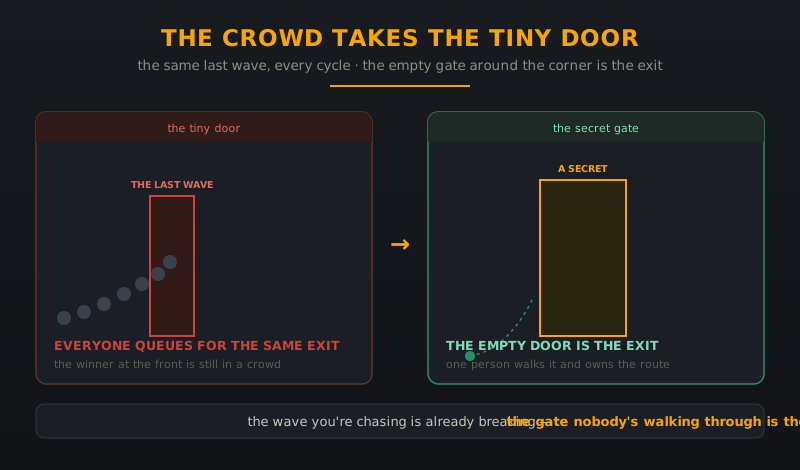
The herd instinct has a reliable tell: everyone working on the same thing at the same time. If your roadmap would survive being pasted into a hundred decks with the logo swapped out, you are not standing anywhere; you are standing in the crowd, in line, at a door that hundreds of people are already walking through. As Thiel puts it, everyone rushes toward a tiny door — and usually around the corner there is a vast, secret gate nobody is taking. The whole art is finding the path no one is walking, then taking it.
The spectrum of truths
The talk's clearest gift is a taxonomy of beliefs, and it stays in the room for days.
Thiel sorts the true things in the world into three bands. Conventions are truths everybody already knows — the price of admitting them is nothing, and the return is nothing. Mysteries are truths nobody can discover, out at the far edge of human reach. Between them sits a band he calls secrets: truths that are hard, genuinely hard, but findable if you apply yourself.
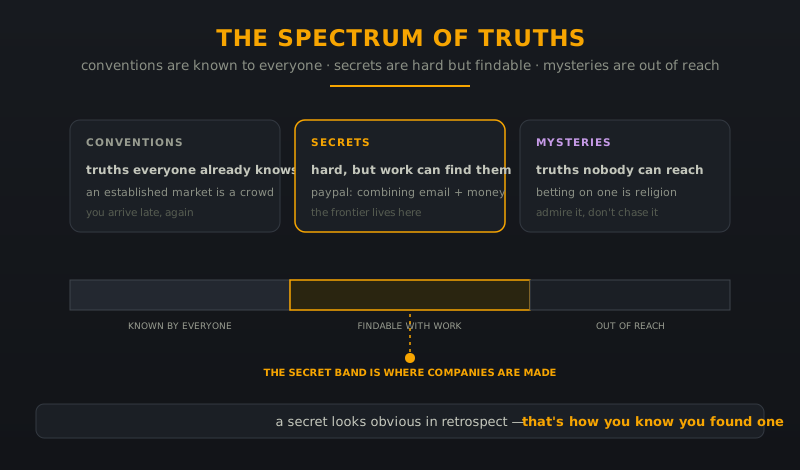
His examples of exhausted fields are geography and basic chemistry — the 17th century had empty spaces on the map, the 19th had gaps in the periodic table, and nobody is going to found a company on those anymore. But most fields are not like that, and the frontier, he argues, is still close. For forty years the IT stack has been a machine for producing secrets; PayPal's "combining email with money" was one, shockingly simple in retrospect, discoverable by exactly the people who did, and invisible to everyone else until it was done. His warning to anyone who finds a secret is the founder's version of a deadline: once you see it, you understand it looks inevitable, so you have to execute fast before anyone catches up.
The uncomfortable implication is that a project without a secret is a project living in the conventions band, and conventional work pays conventional wages. A company is not a real company until it is built on something the rest of the market has not yet agreed to believe. In our vocabulary: a product that cannot name a root cause nobody else has treated is a product that will get exactly the attention its problem commanded — which is to say, the ordinary amount.
One to n, or zero to one
The third of Thiel's contrarian truths gives the talk its title and its best picture. He draws progress as a plane with two axes. On the x-axis: globalization — copying things that work, going from one to n, horizontal and extensive. On the y-axis: technology — doing a new thing, going from zero to one, vertical and intensive. Both are progress. They are not the same progress, and the vocabulary that blends them is the mistake.
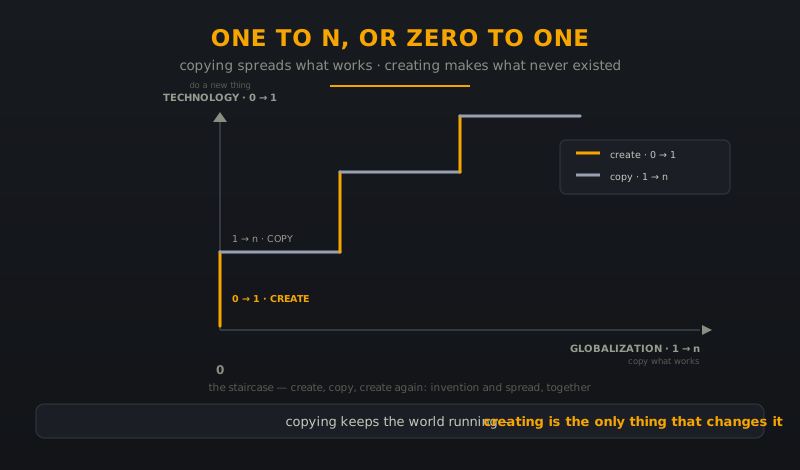
History, in his telling, is this plane in motion. The 19th century moved in both directions at once — invention and global spread at a ferocious clip. After 1914 globalization reversed while technology charged on. And since roughly 1971, the balance flipped again: globalization at full throttle while technology slowed to a narrow beam of work on computers and the world of bits. We even renamed our dichotomies to match, trading the "first world / third world" split of the technological era for a "developed / developing" split that is really a convergence-theory slogan — everyone eventually becoming a copy of the same well-lit place.
The corollary cuts deep: "developed" is an anti-technological word. It means finished. It means this part of the world is where nothing new happens and the younger generation should expect lower living standards than their parents. Thiel refuses that label, and the talk ends on the question that is actually the point of everything before it — the question a studio like ours lives inside every week:
How do you go about developing the developed world?
The wave is a symptom
Here is the root-cause reading of the whole hour, and it is the same trace we run on any failing claim.
The symptom is reported loudly: the market is crowded, the category is red-hot, the wave is cresting and we have to ride it. Everyone treats it as a timing problem and responds with timing solutions — ship faster, raise more, iterate harder. But the trace keeps going, and at the bottom it finds something the crowd refuses to say: nobody in the lane has a secret. The wave is not transportation. It is the moving shadow of everyone who showed up without one.
Symptom:   "the market is too crowded"
     why
Surface:   everyone is building the same product
     why
Layer 2:   we are copying the last winner
     why
Origin:    we don't have a secret of our own
Copying is not a strategy, it is a delay. It defers the painful identification work — the work of holding a truth nobody has agreed to yet — in favor of taking an existing step and walking it again. Walking an existing step is how the world sustains itself, and it is a fine thing to do with someone else's invention. But it is not a company, because it is not a zero-to-one step: the riser under you already existed, and everyone else is standing on it too.
We built ROOT on some of this thinking accidentally and some of it on purpose. FleetOS exists because operators were losing money to invisible faults nobody in the fleet-software category had agreed to treat as the actual problem — a root cause wearing the uniform of a well-served market. Zyren exists because the creator's calendar was wrecking people while the automation category sold content generation — the symptom, not the cause. The eligibility work exists because "policy, as code" is a sentence nobody in the compliance industry had agreed to believe yet; it is a secret, sitting in a bureaucratically obvious place. None of these started from a gap in a market. They started from a truth we refused to let the crowd talk us out of.
The wave question is a good diagnostic, and we use it as one: the more a roadmap item looks like it is riding a wave, the more likely it is a copy wearing a deadline.
Try it this week
- Answer the two questions on paper. What great business is nobody building — name it without naming a product category that already exists. And what is true about your corner of the world that almost nobody agrees with? If both answers name an existing market, you are doing one-to-n and it is time to admit it.
- Place your idea on the spectrum. Convention, secret, or mystery? Conventions get averaged out by the crowd. Mysteries cannot be shipped. The secret band is the only place a company lives — if your idea isn't there, the work is finding the truth that gets it there, not polishing the product.
- Draw the plane. Put your offering on the one-to-n / zero-to-one chart. What is the vertical step — the thing you make possible that did not exist before — versus the horizontal spread? The step is the business. The spread is distribution. If there is no step, the spread is just taking out a loan.
- Delete everything that is "the last wave." Go through your roadmap and kill what you are only building because other people are. The rooms clear fast, and what is left is the only thing the crowd can't take from you.
Go watch the hour
The talk is free on YouTube, from Chicago Ideas and it is short enough to watch twice. Watch it for the law-firm prison break, for the Shakespeare pun, for Thiel telling a room of future founders that their real asset is an unconformed belief. But keep the sentence everything hangs on: there is no formula, which is why the work is finding the secret that is true for you.
Related reading: Competition Is a Symptom, Not a Strategy for what happens when uniqueness fails and the game becomes a fight, Root Cause Thinking for the discipline secrets are made of, and Your AI Feature Is a Symptom for the most common place a late-generation founder tries to turn copying into a plan.