
When AI Became a Commodity, the Moat Moved
- BY
- ROOT TEAM
- PUBLISHED
- SEPTEMBER 5, 2026
- READING TIME
- 7 MIN READ
Frontier intelligence got cheap while nobody watched. The model was never the moat, and open weights proved it. A plain look at where the value moved, and the one test that tells you whether your company still has an edge.
A founder we know raised a round in 2023 around a sentence they repeated at every demo. "Our model is the advantage." By this year the model they bragged about was free to download, the weights were open, and half a dozen teams could run it more competently than they could. The uncomfortable part was not the market. It was the realization that the advantage had never belonged to them. It belonged to whoever held access, and access just stopped being scarce.
We keep watching this exact story repeat, so here is the honest version of what changed, where the value actually moved, and the test that tells you whether your company still has a moat at all.
Intelligence became table stakes
A few years ago the frontier was scarce. The best models lived behind a few doors, the price per unit of capability was punishing, and the gap between what the best model could do and what an open competitor could do was wide enough to build a company on. That gap was the golden age of the wrapper, and every AI startup was really a pricing thesis on that gap.
The gap closed faster than anyone admits. The chart tells the whole story in two lines.
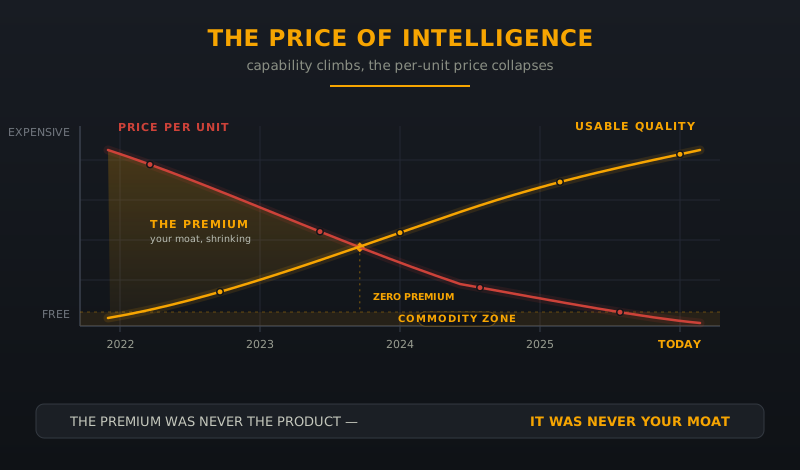
Capability kept climbing. The cost of a unit of it stopped acting like a scarce good and started acting like a commodity. That word gets a bad reputation, but it does not mean the thing is bad. It means the price no longer reflects scarcity. Nobody watches commodity prices move and says "the iron is getting worse." They say "the iron is getting fair." Same thing, applied to intelligence.
The moat was never the model
Open weights did the industry a favor. They exposed the secret underneath most AI startup valuations: the model was the input, not the differentiator. Yes, you fine tuned. Yes, you had a great prompt. A competitor with the same weights and a week of focus can reach you, and the clock on that week has been shrinking all along.
Look at the stack honestly and the layers sort themselves by how fast they can be copied. The interface, your app and your UI, gets reproduced by anyone with a screen recording. The model itself is now the same weights for everyone. Buried at the bottom, in the layer that takes years instead of weeks, is the only part that does not flatten: an understanding of the actual problem.
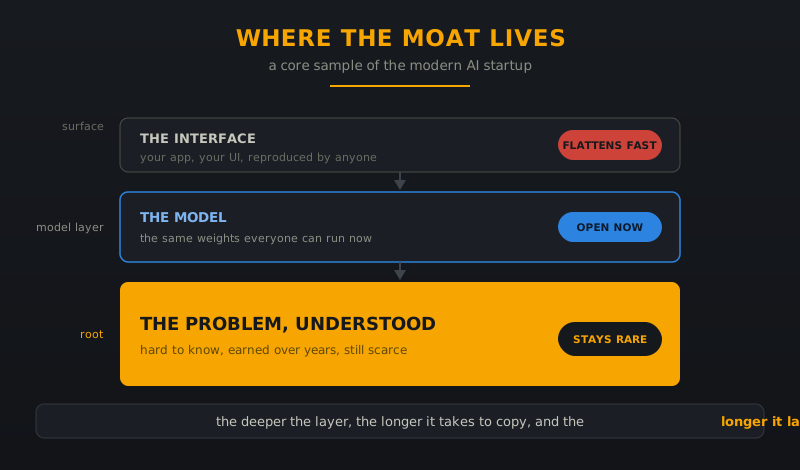
The depth chart is not a metaphor. It is a cost schedule. The closer your value sits to the surface, the faster it gets commoditized. The deeper it sits, the longer it takes to reproduce, and the longer it lasts. Surface layers get cheaper by the quarter. Root layers barely budge.
What stayed rare
Three things survived the opening of the weights, and they are worth naming because every one of them is a skill, not an asset.
The first is depth on a specific problem. A team that has lived inside one domain for years can make a model behave on problems that trip up everyone else. That is not prompt craft. That is knowing which questions are the right ones to ask.
The second is data earned through trust. Not scraped data, not bought data, data that was given because people believed the promise around your product. That data cannot be downloaded, because it was never sitting on a server waiting for someone to grab it. It lives in the relationship.
The third is judgment when the output is wrong. Every model is wrong plenty of the time. The team that knows what to do in that moment, who can read the bad output, find the cause, and fix the course, owns the trust. The team that just regenerates and hopes does not.
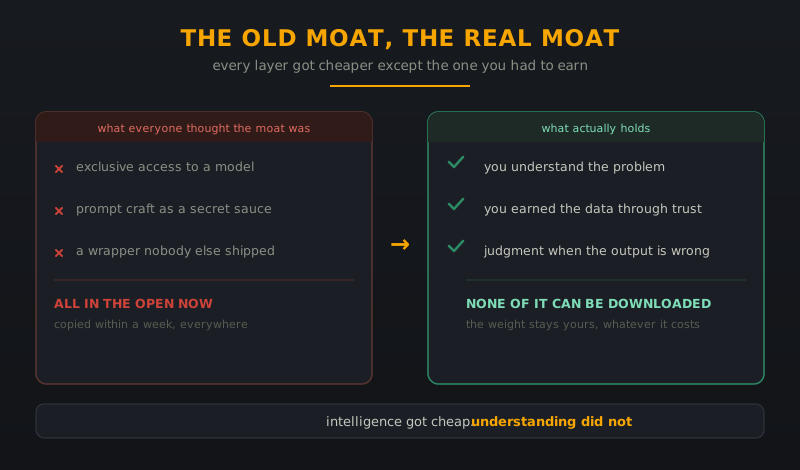
That is the whole repricing in one frame. On the left, the three things an entire era of startups called their advantage, now sitting in the open where anyone can take them. On the right, the three things that stay yours no matter what ships next week. The arrow between them is the biggest repositioning in the industry, and most companies are still standing on the wrong side of it.
This is why ROOT started where it did
We get asked a lot whether open weights threaten our products. The answer is the opposite. The opening of the weights is the best thing that happened to our kind of work, because it removed the best excuse.
For years a founder could pay their way into appearing to understand a problem. Expensive access to a great model stood in for actual depth, and plenty of products ran on that illusion. That option is gone now. When everyone runs the same weights, you cannot fake understanding with a nicer contract. You either know the problem, the data, and the judgment, or you do not.
We never built on owning the best model. We built on the discipline of finding the cause, which is a skill about problems, not about weights. That is why every ROOT product is a trace you can run, a path you can follow, an argument that stands on its own evidence. If a model disappears tomorrow, our work does not. If a weight update ships, our work gets better. Our moat is the understanding, and the understanding was never for sale.
The only test that matters
Run this thought experiment at your next team meeting. Wake up tomorrow morning and intelligence is free. The best open model in the world runs on a laptop, costs nothing, and everyone has it, including your most annoying competitor.
What still stands?
Whatever answers that question is your actual moat. If the honest answer is "not much," then open weights did not hurt you. They revealed you, and you are better off knowing it now than finding out after a funding round. If something still stands, protect that thing with the attention you used to spend on model access, because that is the asset that will still exist in five years.
Symptom:   your AI feature got copied before the launch party ended
     why
Surface:   everyone can run the same model now
     why
Layer 2:   the model was the surface of your product all along
     why
Origin:    access to a tool was mistaken for understanding a problem
Try it
Write down the three things from this post. Depth on one specific problem, data earned through trust, judgment when the output is wrong. Then score your product honestly on each. Most AI companies score high on the third one and discover their first two answers are "everyone has the same." That gap is the whole story of the past two years, and it is the whole opportunity of the next two.
Finding the cause is our daily work.
Related reading: Root Cause Thinking for the philosophy behind this kind of depth, and Traces Are Not Explanations for why raw output never substitutes for understanding.