
Your AI Feature Is a Symptom
- BY
- ROOT TEAM
- PUBLISHED
- AUGUST 31, 2026
- READING TIME
- 8 MIN READ
Every team is shipping an AI feature right now. Most of them are treating a symptom while the real problem sits underneath. This is how a founder tells the difference, and why the teams that trace first build the things that last.
Walk into a boardroom this year and you will see the same slide. Revenue is fine, pipelines are full, and on slide twelve there is an AI feature. It answers questions in a chat box, or it summarizes the meeting, or it sorts the inbox. The slide gets the applause. The only question nobody in the room asks is what problem it actually solves.
This is not an anti AI essay. Used well, this generation of models is the sharpest tool a small team has ever had. The problem is not the tool. The problem is why most teams reach for it. They reach for it because it is new and because their competitors are reaching for it, and they call the gesture a strategy.
Here is the uncomfortable truth. An AI feature is very often a symptom. It is the surface that a deeper problem grew under, and when you ship the surface you do not fix anything. You just make the underlying problem more expensive to ignore.
Why the gamble feels mandatory
Notice the word everyone uses when they talk about adopting AI. It is not should. It is must. We must get something out, we must not be left behind, we must show investors a model in production.
That word is a tell. When a decision is framed as a must, nobody is being honest about what the thing is for. Necessity removes the burden of proof. You no longer have to say what the feature does for the customer, you only have to say that you acted. And because everyone is acting, everyone gets to point at everyone else as the excuse.
Try this thought experiment the next time a feature is pitched as a must. Ask what customer problem it removes. If the answer is a long pause, the feature exists to reassure you, not to serve them. Reassurance is expensive. It costs you the focus you could have spent on a real edge.
The story of the two dashboards
Years ago we watched two teams build nearly identical dashboards with opposite outcomes. This is a true pair, the kind you see repeatedly.
Team one had a headache. Their support inbox was drowning in the same question, asked a thousand different ways. They were hiring support agents as fast as they could train them, and the backlog kept growing. Their instinct was to build a smarter search so customers found existing answers, or a bot that answered the routine questions on its own.
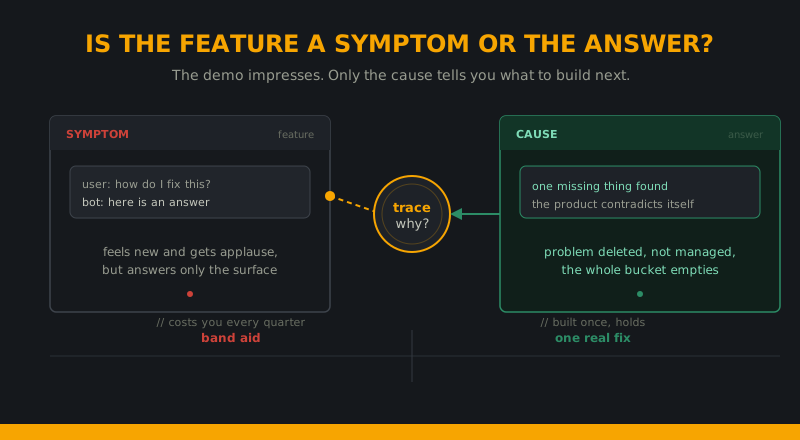
Team two had the same inbox problem with the same complaint on repeat. But before they wrote a line of code, they traced it. They asked why customers could not find the answer, and the answer surprised them. The answer was not that customers were lazy. The product had quietly changed a workflow a month earlier, and the page that should have explained it was showing a version one year old. Customers did not need a bot. They needed the page to tell the truth.
Team one shipped a bot that answered the routine questions and watched as the deeper confusion survived because the product still contradicted itself. Team two fixed the page, and the routine questions stopped being asked at all.
Same symptom. Same complaint. Opposite causes. The teams that fix the cause do not just resolve the report, they empty the whole bucket.
What a symptom costs you
A symptom fix feels cheap because it is fast. That is the trap. Band aids come in the currency of the moment, and the moment is a good month. The bill arrives later, and it arrives in three deductions at once.
The first deduction is trust. When you patch a symptom, the customer still has the experience that created it. They hit the wall again a week later, the bot gives the same unsatisfying answer, and now they think less of the whole product, not just the broken corner. You have spent engineering time to make things feel worse.
The second deduction is money. Every patch that leaves the cause alive is recurring spending. You maintain the workaround, you retrain the model, you rebuy the tool, and because the cause never moved, you do it all again next quarter.
The third is the one that hurts. You trade away the chance to learn the truth. Every real customer problem is a gift of information about what you actually are. A symptom fix throws that information away and calls it progress.
The question that locates the cause
You do not need a framework to find a root cause, you need the discipline of one question asked more than once. The question is why.
Not the accusatory why that blames an engineer. The curious why that refuses to stop at the surface. When a customer reports a problem, the first why gives you the story. The second why gives you the mechanics. The third gives you the assumption, the one nobody wrote down that everything else was built on.
Stop at the answer that names a missing thing instead of a misbehaving thing. The bot did not understand is a misbehaving thing. Nothing confirmed the customer ever learned about the change is a missing thing, and that missing thing is where you rebuild.
This is a tracing habit before it is a technology. It is the habit of asking what the report is standing in for. And it is the single biggest edge a small team has over a big one, because you do not have the headcount to patch a thousand symptoms. You can only afford to fix the few causes that generate them.
Where AI belongs in the answer
Say this plainly. The model is not the answer, it is the operator of the answer. Once you find a real cause, AI can execute it faster than any team that ever lived. That is where its power lives, and that is where most teams point it backward by accident.
The sequence matters completely. Trace first, then automate. If you automate the symptom, you scale the problem. You have hired a model to move faster toward the wrong destination, and it will do that with flawless confidence.
Trace first, and then the automation is pure leverage. You found a genuine repeated cause, you know the exact moment it appears, and the model can watch for it and act at a speed no human matches. That is not a demo feature. That is a machine that closes the real gap in your operation.
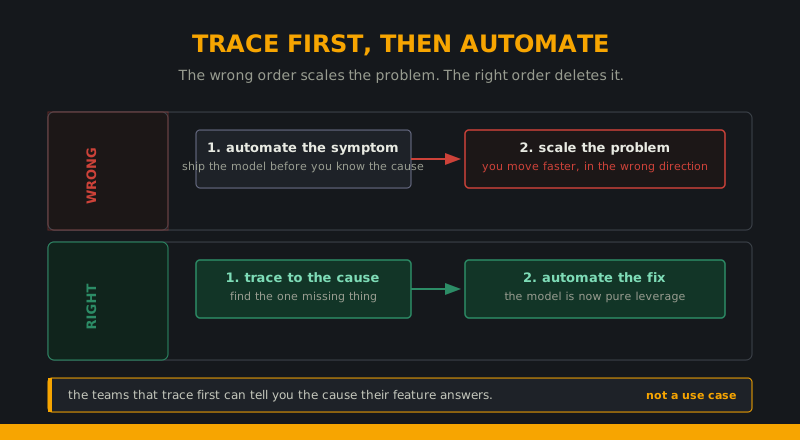
The teams doing this well have one thing in common. When they demo the feature, they can tell you the cause it answers. Not the use case, the cause. A use case is a box you checked. A cause is a customer truth you resolved.
The test before you build anything
Before you greenlight your next AI bet, or before you let the already started one continue, run it through three checks.
First, name the customer truth. Write one sentence about a real person doing a real thing that is harder than it should be. If you cannot write that sentence, the project is not ready, no matter how impressed anyone is by the demo.
Second, name the moment it appears. Every cause has a signature moment, the instant the confusion or the friction first arrives. If you cannot point to that moment, you do not actually know the problem, you only know the report after the fact.
Third, name what breaks if the cause is never fixed. This is the honest one. If the answer is just that you look behind the curve, you have told yourself the real reason, and you are building theater for the slide deck.
One more note, and it is the kindest of them all. It is fine to build theater sometimes. Every company does. The rule is only that you know it is theater. The moment you build it believing it is strategy is the moment the cost starts compounding.
Where we stand
We have spent years teaching people to trace a trouble until they reach the cause instead of the symptom. It is the whole reason this studio exists. We keep a small compass: most products treat symptoms, and we would rather build the thing that treats the cause.
Your AI feature is probably not your problem, and it is probably a hand pointing at one. So before you ship another model, sit with the report that started it and ask why until the answer stops being about the machine and becomes about the missing thing. Find that, and you will know not only what to build, but what the whole company should be building next.
If you want to see the shape of that thinking, our framework and playground sketch out the method step by step. And if you have a feature that smells like a symptom you cannot shake, bring us the trace. Finding the cause is our daily work.