
Your Pricing Page Is a Symptom
- BY
- ROOT TEAM
- PUBLISHED
- SEPTEMBER 1, 2026
- READING TIME
- 5 MIN READ
When revenue stalls, most companies redesign the pricing page. But a pricing page is not a decision maker, it is a mirror. It reflects what the product actually charges for, and what the product charges for was decided somewhere else entirely.
A founder we know spent a quarter obsessing over pricing. New tiers, new numbers, three separate redesigns of the page, two rounds of user interviews about willingness to pay. Conversion moved by a rounding error. Eventually someone on the team asked a different question. They asked what the product actually did in the first five minutes after signup, because customers kept churning before they ever saw the value they were being asked to pay for. The pricing page had been optimized for two quarters while the thing being priced was broken in a way no pricing change could fix.
That pattern is everywhere once you learn to see it.
The page is downstream
Here is the uncomfortable chain. A pricing page states a price. The price states what the company believes the product is worth. What the product is worth is determined by what it does, for whom, and how reliably. So when the pricing page underperforms, the page is almost never the cause. It is the last link in a chain that starts somewhere the pricing team cannot see.
Treat the page as the problem and you get the classic loop. Redesign the page, run A to B tests, watch conversion twitch sideways for a week, then settle back to where it was. Each iteration costs a design cycle and buys almost nothing, because every test is measuring the wrapper while the contents stay the same.
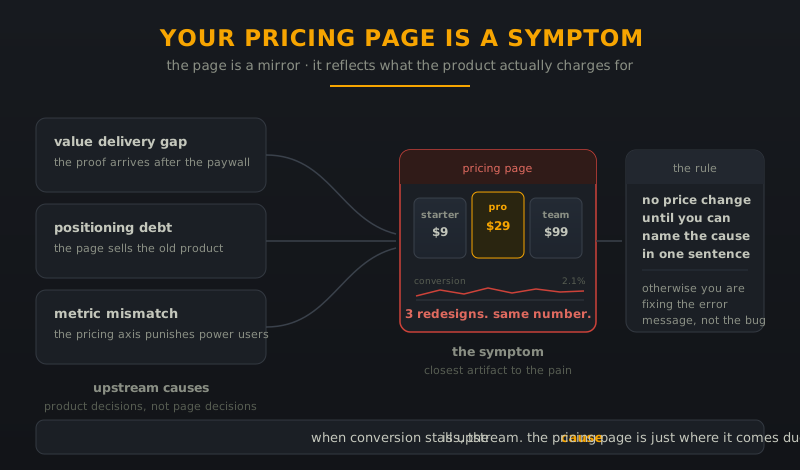
The same reasoning that finds a bug in the code rather than in the error message applies here. Nobody ships an error message change and calls the bug fixed. But with revenue, companies do the equivalent constantly, because the pricing page is the most visible artifact closest to the symptom.
Where pricing problems actually live
We have seen three upstream causes account for most stalled pricing pages.
The first is a value delivery gap. The product promises an outcome and delivers it too slowly or too indirectly for the customer to feel it before the paywall. When people say the price is too high, they very often mean the value arrived too late to justify it. The fix is not a lower price. It is a shorter path to the moment the product proves itself.
The second is positioning debt. The product grew features for one audience while the pricing page still speaks to an older one. The page sells what the company used to be. No layout fixes that. Only deciding who the product is for now does.
The third is a metric mismatch. The pricing dimension, seats or events or records, does not track the value customers receive, so heavy value customers feel punished and light ones feel overcharged. Every pricing redesign on top of the wrong dimension is rearranging furniture.
Each of these is a product decision wearing a pricing page costume. And each one is fixable, but only upstream, where the cause is.
How to trace it
The diagnostic is simple and almost nobody runs it. Sit next to five recent churned or non converting customers and watch, without helping, the path from their first visit to the moment they decided not to pay. Write down the first moment their intent dropped. Then ask why that moment happened, and keep asking why until the answer stops being about the page.
In most sessions the first intent drop happens well before pricing. A confusing first screen, a setup step that asks for more than the value delivered so far, a trial that starts on an empty account. The pricing page is where those upstream failures come due, which is exactly why it looks like the problem.
The uncomfortable conclusion
A stalled pricing page is one of the clearest signals a company can get, and one of the most consistently misread. It usually means the product's promise and the product's behavior have drifted apart, and the pricing page is simply the first place a customer can see the gap and act on it.
We think pricing redesigns should come with a rule, the way bug fixes do. You are not allowed to change the price until you can name the upstream cause of the stall in one sentence. If you cannot, you are treating a symptom, and the symptom will be back, wearing a different layout.
Try it this week
Open your own pricing page and read only the headline and the tier names. Then open your product's first session and ask honestly whether the first five minutes deliver what those words promise. If the honest answer is no, you do not have a pricing problem, and every dollar spent on the page is a dollar spent downstream of the actual bug.