
Local First Software Is Quietly Winning
- BY
- ROOT TEAM
- PUBLISHED
- SEPTEMBER 6, 2026
- READING TIME
- 7 MIN READ
Software that works when the server dies is winning the teams that try it. Here is why the next wave of tools will treat offline as the default, not a fallback, and how a small studio builds that way on purpose.
A team we know runs their whole operation on a scheduling tool. Truck routes, driver availability, dispatch notes, all of it. One Tuesday the weather took out the connection, and the tool they trusted did nothing wrong at all. It simply stopped. Every screen went to a retry spinner, and the dispatcher sat with a working laptop and yesterday's printed route list and no way to change a single assignment for four hours. The software did not crash. Nothing broke. It just could not work without the one thing that was gone.
That is the moment a product stops being software and becomes a promise that the network will behave.
The test every tool fails
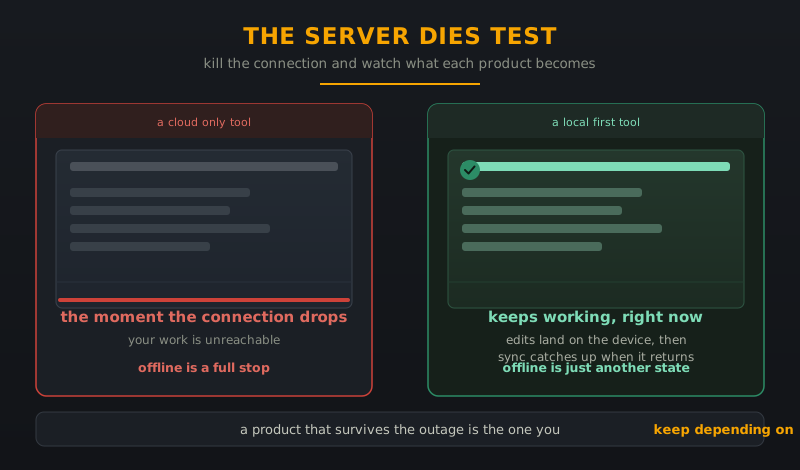
Ask this of every tool you depend on: what happens when the server dies? Not eventually. Not tomorrow. Right now. Turn off the laptop's network, walk into a parking garage, and open the thing you run your business on. If the answer is a spinner, you bought a product that requires a stranger's equipment to function.
Most tools fail this test instantly, and nobody thinks twice about it. We have come to accept that software is something that runs elsewhere and we borrow it through a pipe. When the pipe closes, there is nothing to borrow. The strange part is how recently this became the normal shape of things.
What local first actually means
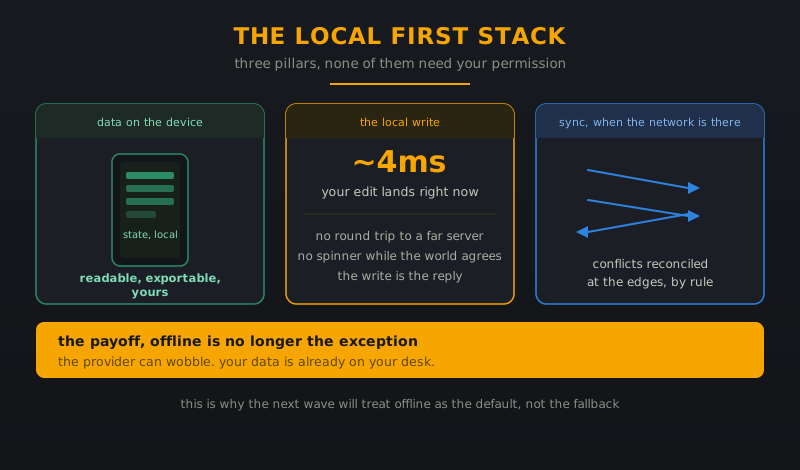
Local first is the movement that treats that answer as unacceptable. The data lives on your device. Writes land locally in milliseconds. Sync happens when the network is around, quietly, in the background. Conflicts get reconciled at the edges by rules, not by making the user wait for a server to approve every keystroke.
It is not a retreat from the internet. It is a reordering. The device becomes the source of truth, and the network becomes a bonus that makes sharing and backup painless. Offline stops being a failure state and becomes just another mode the software knows how to sit in.
That single reordering changes what a product can do, what it can promise, and who can trust it.
How we ended up here
The obvious question is how we got the opposite arrangement in the first place. Trace it the way we trace every problem and the answer is boring, which is usually the sign you have reached the cause.
Symptom:   your tool dies with the connection
     why
Surface:   the state lives on a server you do not control
     why
Layer two: the product was drawn around an always connected world
     why
Origin:    the cloud was a convenience, mistaken for a requirement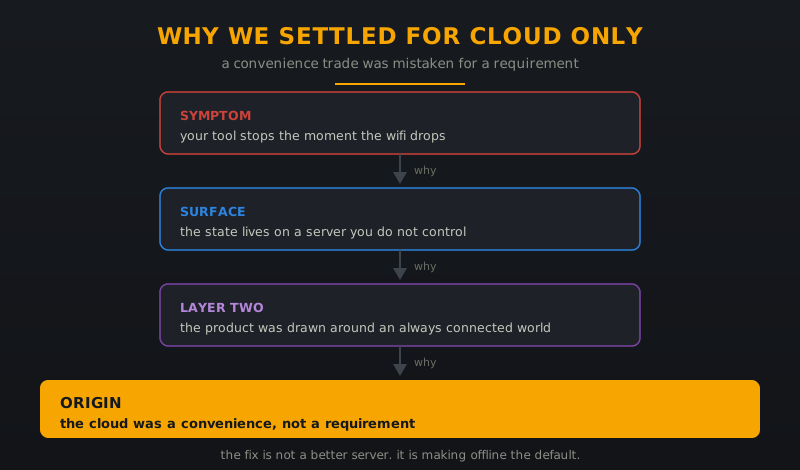
That last line is the whole story. Cloud software was a genuine convenience. No installs, no backups on your hard drive, no synchronization to figure out. But a convenience is a trade, and trades have a cost that shows up later. Somewhere between the spreadsheet and the sales pitch, the trade became a given. Nobody decided offline access was impossible. It was simply not designed for, and the absence of design got treated as a law of physics.
The root cause was never the cloud. It was treating a convenience as a requirement and then building everything downstream on that assumption.
What changes when offline is the default
Flip the default and four things happen, all of them worth wanting.
One, latency stops being a god. Software no longer has to wait on a round trip to feel fast, because the fast path is local. The milliseconds that a server round trip used to cost become milliseconds a product spends doing something useful instead. Speed stops being a promise about our infrastructure and becomes a property of the code.
Two, the product gets honest about state. A cloud only tool can pretend it is always right because it is always talking to the single source of truth. A local first tool cannot. It has to say what is saved, what is being worked on, and what is waiting on a sync. That honesty is the difference between a tool that surprises you and a tool you can trust with your day.
Three, the interesting engineering moves to the margins. The hard problem is no longer "how do we serve a million users," it is "how do two devices with different edits agree." Conflict resolution, reconciliation, storage migration. That is where the craft lives now, and it is a better problem to have, because the users never feel its failure as a spinner.
Four, portability appears as a side effect. If the data lives on your device in a format that is yours, then leaving a tool does not require a heroically engineered export. Your data was never theirs to begin with. The trap that most products quietly build around your data cannot survive a design where the data was never held hostage.
The honest price
None of this is free, and it is dishonest to pretend otherwise. Sync is a genuinely hard problem. Multi device reconciliation, conflict resolution, storage migration, those are real systems that must be built or borrowed well. Most products skip them because skipping is cheaper and faster, and a team inside an office building with fiber cannot feel the absence from their chair.
Building local first is buying durability with complexity. It is a good trade, but only when it is deliberate. The products that win with this approach are the ones that ship the hard sync layer on purpose, because they have decided that the promise matters more than the launch date.
What we do about it
We build local first on purpose, and not because it is fashionable. It is the shape of software we actually want to depend on.
Verdix, our eligibility engine, carries the stance in its own description: no network, no dependencies, no guessing. The rules live in your repository, the evaluation is deterministic on your machine, and the verdict is a function of your inputs. It does not degrade when our services hiccup, because your eligibility does not depend on our services at all. Same inputs produce the same output every time, on your desk, in the dark if it comes to that.
The same instinct runs through everything else we ship. If the state can live locally, it lives locally, and whatever syncs is treated as an optimization rather than as the source of truth. We would rather sell you a tool that works in a parking garage than one that needs a datacenter to tell you where you are.
The question worth asking
Find the tool you lean on hardest and run the test. Turn off the network and open it. Watch what it gives you: which screen, which error, which apology. Then ask whether "needs a connection to think" is a requirement of the problem you are solving or just a habit of the product. Most of the time it is the latter.
Reach the next layer and you find the same pattern as every other root cause we chase. The tool was shaped around an assumption nobody inspected. The assumption was inherited, not chosen. And the fix looks dramatic until you do it, at which point it looks obvious, just offline as the default and the network as the bonus it always should have been.
That reordering is winning quietly, one parking garage at a time.
Related reading: Your Data Deserves a Leave Anywhere Guarantee is the downstream promise that local first makes real. Root Cause Thinking covers the philosophy behind building from first principles.