
Subscription Fatigue Is a Business Model, Not a User Problem
- BY
- ROOT TEAM
- PUBLISHED
- AUGUST 30, 2026
- READING TIME
- 6 MIN READ
The average household pays a few hundred dollars a month and can't list what for. That isn't a budgeting failure. It's the business model working exactly as designed. Here's the root cause, and what an honest fix looks like.
Pause for a second and try something: list everything you pay for every month. Not just the obvious ones. All of them. The streaming services, the cloud storage, the fitness app you opened twice, the newsletter, the free trial that quietly stopped being free.
Most people name four or five and give up. The average household spends a few hundred dollars a month on subscriptions and underestimates the total by a wide margin. We run this exercise in research conversations, and almost nobody finishes the list.
This post is about why that is, and it's not a willpower problem. Your subscription list is not a mess because you're disorganized. It's a mess because the market is built to keep it invisible.
A business model that runs on forgetting
Look at the three engines underneath the subscription economy and you'll see the same design goal three times.
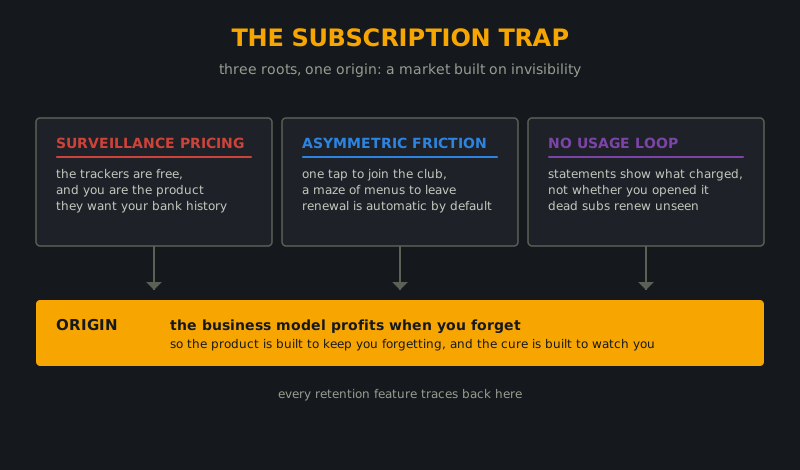
Free tools that sell you later. Signing up costs nothing, which is how these products got their millions. That first month is priced at zero to get you in the door, and plenty of "money management" tools turn out to be priced in a different currency: your data. The tracker is free because you're the inventory.
One tap in, a maze out. Joining takes one tap. Leaving takes support menus, retention offers, a week of reminder emails, sometimes a phone call. Renewal is automatic by default. Cancellation is manual by design. That asymmetry isn't an accident, it's the business.
Invisible renewals. Your statement shows what was charged. It does not show whether you used the thing. Dead subscriptions don't announce themselves, they just renew. There's no feedback loop that says "you haven't opened this in eleven months." The product is structured so you never have to make a conscious decision about it, and that's the point. A product that gets forgotten can't be cancelled.
Run these backwards and they converge on the same sentence, the same way every bug we trace does.
Symptom:   a forgotten trial renewed at full price
     why
Surface:   leaving took six clicks through a retention offer
     why
Layer 2:   renewal is automatic and cancellation is work
     why
Origin:    the business model profits when you forget
That origin sentence is the whole industry. Not one app acting badly, but an incentive shared by nearly all of them: revenue is highest when the customer stops thinking about the product. "Easy to use, hard to leave" isn't a bug in the subscription business. It's the business.
The cure that copies the disease
So the market invented a fix: bill tracker apps. And this is where the root cause gets interesting, because the fix rebuilt the same disease.
Almost every tracker wants you to connect your bank account and hand over your spending history. Read that twice. A tool built to give you control over your subscriptions requires you to give another cloud company command over your entire financial life. Your legitimate desire to tidy your subscriptions has become a fresh source of data to be harvested and sold. The tracker is free, again. You're the product, again.
That's the textbook symptom-level fix. It treats the visible failure, "people can't see what they pay for," and then reconstructed the exact cause underneath it: a company that profits from watching you. The data collection is the product. Helping you cancel the odd service is the demo.
What an honest fix looks like
A root-cause fix starts from a different assumption. Your financial data is yours, and it never needs to be sent anywhere. The whole job can run on your own device.
- Pull your statements and card exports into a tool that stays local. Nothing leaves your machine.
- Detect the recurring charges and group them into one clean list, so you can finally see the whole thing at once.
- Score actual use, so a service you haven't opened in a quarter shows up as dead weight instead of a mystery.
- Act in one tap, straight into the cancel or downgrade flow, no maze.
- Get a plain language monthly report: what renewed, what could be cut, what changed.
The economic stance matters as much as the features. The honest answer to "free" is to not be free, and to not be the product. A tool that runs on your device and costs a fair one-time price has no incentive to hide anything from you, because its success is your success. You pay it once, and it makes the rest of your month cheaper. That alignment is the actual fix: the business only wins when you win.
The business lesson for founders
This pattern isn't only about consumer apps. Every product decision carries the same question: when does our incentive stop lining up with the customer's? The moment you build retention mechanisms, hidden renewals, or engagement loops that exist to prevent a person from choosing, you've built a symptom. The cause is the version of your business that profits from making people worse off.
We keep a simple compass here: treat the cause, be honest, and let people leave. Refund a payment without a fight. Make cancellation one tap. Publish what you charge, plainly. There's a strange truth at the end of this: the subscription company that customers can always see and always leave is the one that gets kept. A service with no open-ended claims has nothing to hide and everything to prove.
Try it on your own statement
Pull your last credit card statement and make the list. Every recurring charge, written down. Then mark three things beside each one: when you last opened it, whether it made anything easier, and whether you'd re-join it today at full price.
The entries with no answer to any of those three are your dead weight. Most people find a hundred dollars a month or more in about twenty minutes. The problem was never that you don't manage money. It's that half your stack was designed to never be seen.
If you'd rather hand us the problem, that works too. Finding the cause is our daily work.
Related reading: Subscription Sovereignty is the full sketch of the local-first fix. Root Cause Thinking covers the philosophy behind building from first principles.