
On Device AI Is Ending the Privacy Tradeoff
- BY
- ROOT TEAM
- PUBLISHED
- SEPTEMBER 7, 2026
- READING TIME
- 7 MIN READ
We accepted that private work had to run on a stranger's computer. Local models just got good enough to change that. Here is why the cloud was a convenience trade disguised as a requirement, and what happens when inference moves back onto the device.
Ask someone why their calendars, photos, and drafts live on someone else's computer and you will get a shrug. That is just how it is. The machine on your desk is weak and the machine in the cloud is strong, so the heavy work happens up there and your input travels to meet it.
For a long time that answer was true. Ten years ago the phone in your pocket could not run a useful model and the laptop closed its lid at night because the real compute lived elsewhere. Offloading was not a choice, it was the only way to get the capability at all.
That constraint is gone. It has been going away quietly for a few years now, faster than most products admit. And with it, the famous tradeoff that privacy tech has been negotiating against for a decade is not fading, it is just no longer necessary.
The privacy tradeoff, named
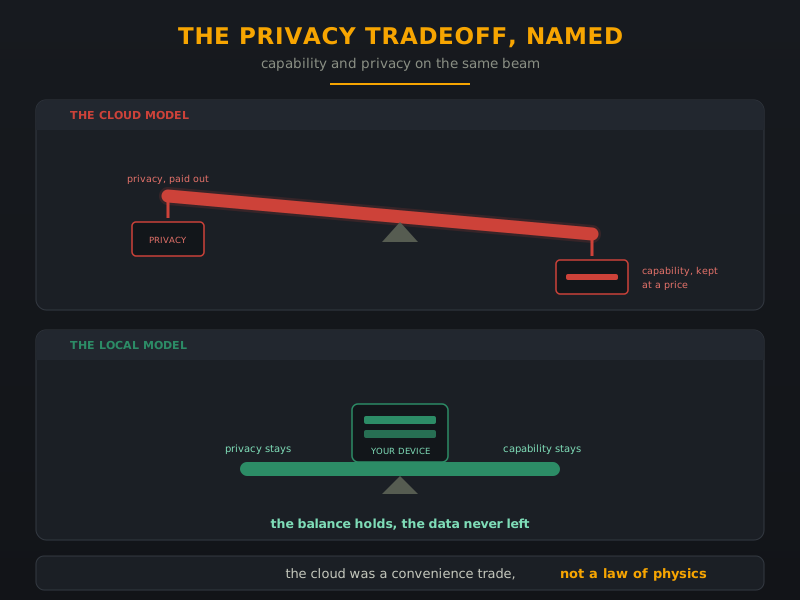
Everyone who thinks about this has heard the framing. You get convenience and intelligence by sending your data to a centralized service, and you pay for it in exposure. Low latency, strong models, constant features. The price is that your trust lives at the data center, protected by a stranger's policy, a stranger's staff, a stranger's patch schedule.
The product writes it as a feature. The privacy community writes it as a tax. Both are describing the same bilateration: your data and the capability cannot be in the same place unless you accept that the place is a server you do not control.
The one assumption nobody checked
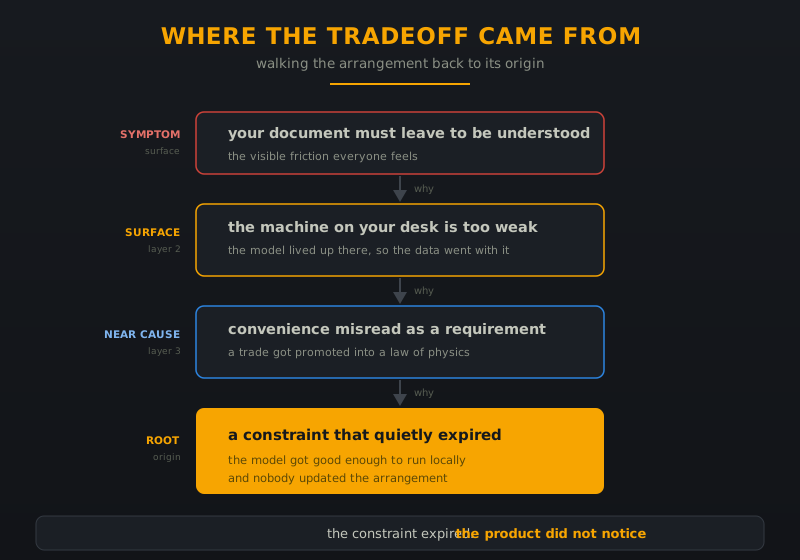
Spend the extra layer of attention and you find the whole arrangement rests on a single sentence, the one from the opening. The machine on your desk cannot do the work. People repeated it until it was geology and built entire product categories on top of it.
That sentence stopped being true around the time local models became small and fast enough for actual work. Not toy demonstrations. Real work, the kind that answers a question, rewrites a draft, tags a photo, summarizes a meeting, runs a client-side classification, and finishes before the human notices a wait. A phone does this today. A laptop does it better.
The consequences of that shift are the story, but they are not about chips. They are about what a product is allowed to promise when the capability no longer requires shipping your input anywhere.
What actually changes
Flip the assumption and four things change, and each one changes the trust calculus rather than the tech.
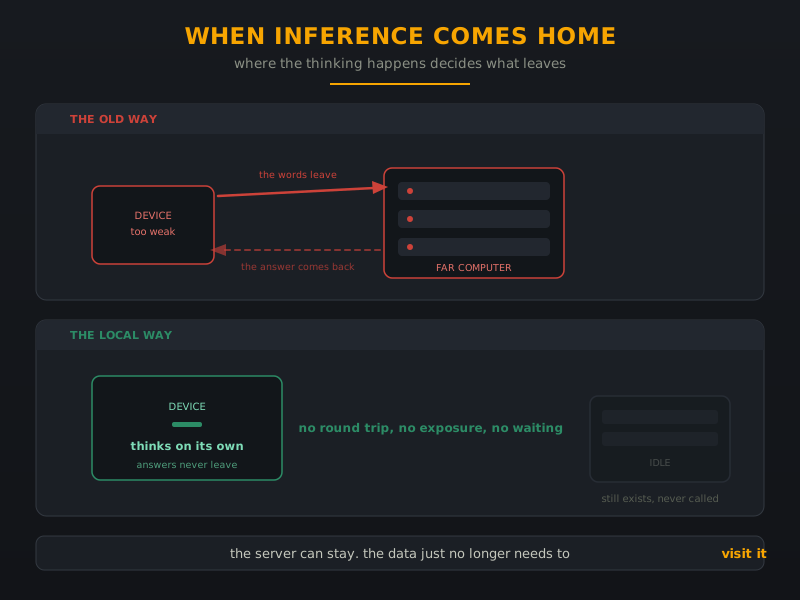
One, the round trip becomes optional. Today a model call is a network call. You send the words, the words cross cables, a far computer thinks, the answer crosses back. Local inference removes the middle of that journey. The input, the model, and the output all stay inside the same enclosure. That is not a speed tweak, it is a structural difference in where your thoughts are allowed to exist.
Two, exposure stops being the price of intelligence. When the work happens on your device, your draft, your photo, your health note, and your message do not have to be copied onto a machine run by a third party to be understood. They are processed in place and the evidence of what you asked about does not travel. The capability and your data finally share a roof, and the roof is yours.
Three, offline stops being a mode and becomes a default. A product whose inference runs locally works in a parking garage, on a plane, in a datacenter's shadow. It is honest about the connection because it was never designed around it. The local first instinct that is winning across software, as it did for the tools we covered here, reaches the one pile still nervously wired to the cloud.
Four, the meaning of a vendor changes. When the intelligence comes from a weights file that lives on your disk, the vendor that trained it becomes a supplier rather than a watcher. Your ongoing use no longer requires constant surveillance by the thing you bought. That is the deepest shift of the four, and also the one products are least excited to talk about.
The honest limits
None of this is magical and honesty matters here more than anywhere. Local inference gives up something. The largest frontier models still want more memory and more cores than a sane consumer machine has, and for the genuinely hard long-context reasoning that margin is real. A spreadsheet from the late nineties does not replace a datacenter, either.
So the claim is not that local inference beats the frontier on every benchmark. It does not have to. The claim is narrower and stronger: for the everyday intelligence work people actually hand over, a capable on device model is now good enough, and the privacy win is so large that the remaining gap is worth the trade when the data is private. People already choose a smaller screen or a thicker phone for the same reason. Choosing a smaller brain on purpose so your words never leave the room is the same arithmetic pointed at freedom.
That is not nostalgia for old silicon. It is the opposite. It is the tool finally becoming good enough to let the architecture be honest.
What we build on this
We carry this stance into the products we ship, because the declaration is useless if the product does not honor it.
Verdix, our eligibility engine, runs its rules deterministically on your machine. The evaluation does not phone home for a verdict. Same inputs produce the same answer on your desk, in the dark, with the network cable pulled. The intelligence that decides an outcome does not require your problem to visit our servers.
The same instinct is why we treat local state as the source of truth and the sync layer as an optimization, not the other way around. If the work and the data can live on the device, they live there, and whatever leaves does so by an explicit export, not by ambient habit. That is the product we would want to depend on, so it is the product we build.
The question worth asking
Take the assistant you lean on hardest and ask one honest question. When you hand it that private paragraph, that calculation, that name, does the answer require the words to leave your device to be understood?
Old products have only one answer. The new ones, the ones built on local inference, have a second one, and that second answer changes what they are allowed to promise. They can offer capability that does not demand your exposure as the admission price.
That is the tradeoff ending. Not because privacy won an argument, but because the constraint that forced the argument quietly expired. The cloud was never a law of physics. It was a convenience trade made while the computer in your pocket was too weak to protect you, and we kept paying the bill long after the excuse went away. Now a capable model fits in the same room as your data, and the only remaining question is whether the products you use will let you keep both. The good ones will.
If you want to try software that already made the call, ours keeps your eligibility local by design. Finding the cause of why your data had to leave in the first place is our daily work.
Related reading: Local First Software Is Quietly Winning covers offline as the default. Your Data Deserves a Leave Anywhere Guarantee is the promise this architecture makes real.