
From Symptom to Source: The Five-Step Trace We Run on Every Problem
- BY
- ROOT TEAM
- PUBLISHED
- AUGUST 27, 2026
- READING TIME
- 6 MIN READ
Broken systems announce themselves through symptoms. This is the five-step trace we use at ROOT to walk a bug report backwards until it becomes one fixable cause.
A problem rarely presents itself as a single defect. It appears as several unrelated bugs: a checkout that fails intermittently, orders that disappear at noon, duplicate charges, and a dashboard with incorrect totals. The common response is to open four tickets and assign four engineers.
That response costs more than it looks. Four tickets mean four investigations, four patches, and four code reviews. None of them touches the real defect, so all four problems return.
At ROOT, every project runs the same five-step trace before any fixing code is written. It is the pipeline shown in the terminal on our homepage. This document describes each step so you can apply it to your own systems.
The trace at a glance
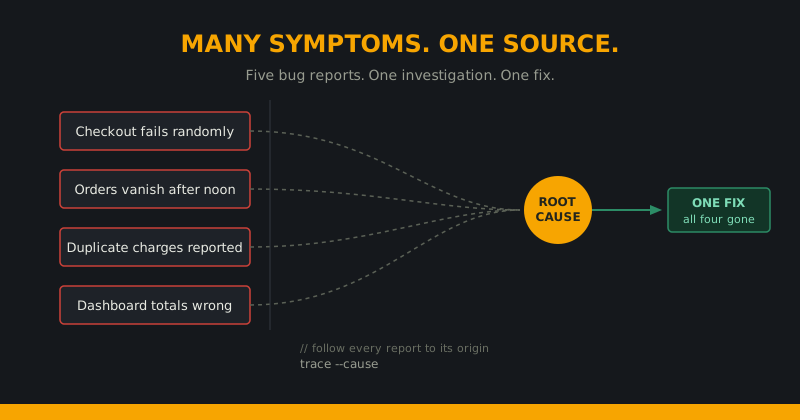
Five symptoms reported. One investigation run. One cause found. One fix shipped, and all five reports close together. That convergence is the core principle: symptoms are parallel outputs of a single source. The objective is not to silence each output but to find what produces them.
The five steps:
- Intake: capture the problem exactly as it was reported.
- Signals: cluster every related report into one dataset.
- Depth: walk from symptom to infrastructure to origin.
- Cause: prove which single source explains them all.
- Fix: repair the source once, then verify the symptoms ended.
None of these steps require cleverness. They require discipline, particularly at step two, where most teams skip ahead.
Step 1: Intake without interpretation
When a user reports "checkout fails randomly," resist translating the report. "Randomly" usually means "on a schedule I did not notice" or "for data shapes I do not have." Record what the user said, what they expected, when it happened, and what they were doing before forming any theory.
# Incorrect intake (theory embedded):
#   "Payment provider is flaky"

# Correct intake (observation only):
#   2026-08-14 12:04 UTC, checkout 500, order #8841,
#   EU region, cart contained a discounted + full-price item
This discipline matters because a theory written at intake time filters everything discovered afterward. Intake should remain factual; theories belong to later steps.
Step 2: Signals, not anecdotes
One report is an anecdote. Twelve reports are a pattern. Before tracing anything, gather every related report: support tickets, error logs, and undocumented workarounds users created because filing a bug felt pointless.
Cluster them by what the user lost, not by which service they touch. Symptoms that look different on the engineering side often look identical on the user's side. In this example, failed checkouts, vanishing orders, duplicate charges, and incorrect dashboard totals all describe the same loss: a transaction that half-happened.
The clustering result is the first reliable lead. Something in the system allows transactions to commit partially, and four separate dashboards never detected it because each one monitored only its own layer.
Step 3: Depth, past the patch
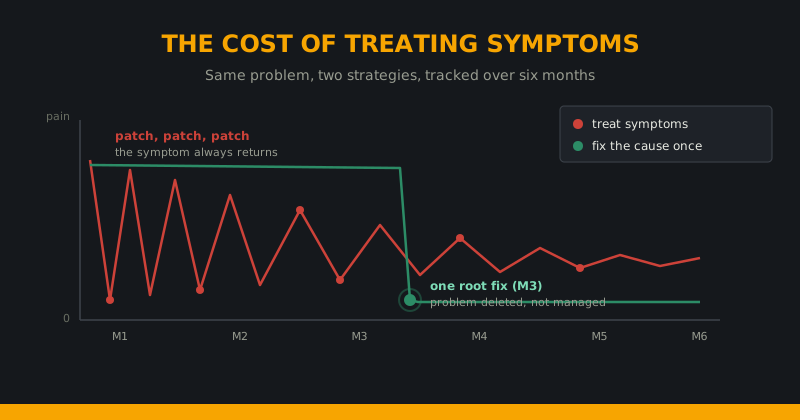
This chart demonstrates why depth matters. The red path represents the standard approach: patch the visible failure, observe a short period of stability, then watch the pain return slightly different and slightly worse, because the patch added moving parts while the underlying fault remained. After six months the team has shipped six patches and the problem remains on the roadmap.
The green path is slower early on. Months one and two look identical while the trace runs. Then one intervention in month three removes the problem permanently instead of managing it indefinitely.
Walking depth follows this pattern:
Symptom:   checkout returns 500 "randomly"
     ↓ why
Surface:   payment webhook handler times out
     ↓ why
Layer 2:   handler holds a DB lock for up to 30s
     ↓ why
Origin:    discount + full-price carts trigger a retry loop
           written before partial-checkout states existed
Each arrow is a question asked of the code, the logs, or the original author: why does the layer above behave this way? Stop when the answer changes from "because component X does Y" to "because nobody had built Z." That final statement is the foundation. Nothing sits beneath it, and everything above depends on it.
Step 4: Prove the cause before fixing anything
A suspected cause has little value until proven. Step four prevents the team from shipping patch number seven.
Run the causality test in both directions:
- Forward: if the source behaves as believed, does it predict every signal in the cluster, including anomalies such as why only afternoon orders vanished?
- Backward: can the symptoms be reproduced reliably by creating the condition, and removed by eliminating it?
If either direction fails, move back one layer and continue investigating. A correct root cause explains all symptoms with no exceptions. Remaining symptoms indicate an incomplete cause.
Step 5: Fix the source, then verify
The final step has two halves. First fix the origin: in this example, replace the retry loop written before partial-checkout states existed rather than adjusting the webhook timeout. Then verify downstream. The four original reports should close within days without manual action. If they remain open, return to step three because another source was contributing.
A successful trace contains no timeout patches, no added retries around the webhook, and no reconciliation cron jobs. Each of those would have worked briefly and introduced permanent maintenance cost.
The trade
Tracing feels slow in the moment. Competitors ship their third patch while the investigation continues. Measured across six months, however, five or more patches plus recurring incidents cost far more than one deliberate fix followed by silence.
The larger benefit extends beyond the fixed bug. Every trace documents which layer owns which behavior, which assumptions carry load, and which quick fixes exist as future risks. Teams that trace regularly build faster because their understanding compounds alongside their code.
Apply it
Select the ticket on your board that reopens most often. Collect every instance of it. Ask why repeatedly, recording each answer, until you reach a sentence about something missing rather than something misbehaving. Fix that sentence.
If you prefer to hand us the ticket instead, that works too. Running this pipeline is our daily work.
Related reading: Root Cause Thinking covers the philosophy behind first-principles building.