
The Agent Did Something Wrong. Now Find the Why.
- BY
- ROOT TEAM
- PUBLISHED
- AUGUST 27, 2026
- READING TIME
- 5 MIN READ
AI agents fail all the time. The tools we built can show you what they did. Almost none of them can tell you why. Here is the debugging gap nobody has fixed, and how a root cause trace closes it.
An agent that runs for four hours does a lot of things. It reads a dozen files, calls search, rewrites a function, and then, on the last step, it does the wrong thing and stops. The log tells you what it did. It cannot tell you the moment it went wrong or why it chose that path. That is the problem this post is about.
We have spent years teaching people to trace a bug backwards until they reach a cause instead of a symptom. The AI agent has become the strangest test of that discipline yet, because the thing that decides is not code you can step through. It is a model that took a path for reasons nobody recorded.
The reproduction is broken
With a normal service, debugging follows a simple loop. Reproduce the failure, find the defect, fix it, verify. Reproduce is the first word. An agent does not honor that word.
Send the same prompt twice and the agent can take a completely different route. The second run might succeed where the first failed, or fail somewhere new. Nothing about it is stable enough to reproduce, and without a reproduction you are not debugging, you are narrating logs and hoping.
That is exactly where current tooling leaves you. Open the trace, scroll through a thousand spans, and slowly piece together what happened. It reassures you that a record exists. It does not answer the only question you actually have, which is why.
The what is solved. The why is not.
Observability for agents grew fast. There are platforms that capture every tool call, every prompt, every token count, and every cost. That is genuinely useful, and it is also the easy half. It answers what an agent did. Nobody has reliably answered why.
The why lives inside a neural network. You cannot open it like a stack trace and read the frame where the decision turned sour. But here is the thing. You do not need to open the model. You need to capture everything the model saw, and then walk the failure back to the specific context that pushed it off course. Agents are still deterministic in a practical sense. Every decision follows from the instruction, the accumulated context, and the tool result at that moment. Record all of those at every step and the why becomes traceable again, just like a cause in a five step trace.
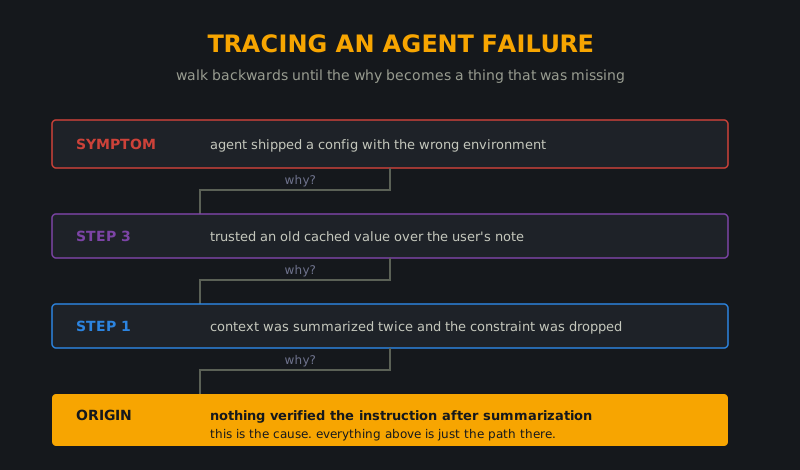
A trace looks like this
The failure is usually not where it seems. A wrong final answer often comes from something early that quietly steered everything after it. So the trace walks backward through layers, and each layer asks why.
Symptom:   agent shipped a config with the wrong environment
     why
Step 3:    agent trusted an old cached value over the user's note
     why
Step 1:    context was summarized twice and the user's constraint dropped
     why
Origin:    summarization compressed the instruction and nothing verified it
Stop when the answer stops being about what the agent did and becomes about what nobody built. That last line, nothing verified the instruction after summarization, is the cause. Everything above it is just the path there.
What makes the why possible
To find the why you have to undo the chaos of non determinism. Three things make that real.
First, capture everything. Save the prompt, each tool call, the exact context at each decision point, and the result. Not summaries after the fact. The actual state at the moment of the decision.
Second, take checkpoints. When an agent works for hours and then fails, you never want to lose the run. Save snapshots at major milestones so you can restore and replay from any point. Replay lets you change one thing, fix the stale result or restate the constraint, and watch the path correct itself.
Third, branch compare. Run the path that worked next to the path that failed, and the difference is your cause. When one path stops for a discarded context and the other carries it through, you have found your moment.
Watch the symptoms compound
The wrong output is rarely the whole story. Long sessions show the failure building for a long time before it lands. Context drift, where an instruction from the start gets diluted or contradicted by turn thirty. Runaway cost, when an agent replans in a loop instead of deciding. A tool call that arrives well outside the pattern. Each is a symptom with a source underneath it, and each is catchable before the session ends in a mess.
This is the same shape as every other root cause we chase. The reports look unrelated, but they come from one source. Find the source and they all close together.
Why we are building it
We keep a simple compass here. Most products treat symptoms, and we try to build the thing that treats the cause. The agent debugging market created dashboards and stopped. They count logs and call it understanding. The actual problem sitting in front of every team that runs an agent is that they cannot find why it failed. That is the gap, and it is the one worth building from.
You can see the full sketch of this thinking in our ideas playground under Agent Root Cause Intelligence. It is early, and it is hard, but the cause is clear. Teams do not need another graph of what an agent did. They need one honest sentence about why it went wrong.
Try the trace on your own agent
Take the last agent run that failed and lost you time. Pull its full context, not the summary. Find the moment the plan went wrong, then ask why at that moment, then ask why again, until you reach a sentence about something missing rather than something misbehaving. That sentence is your cause.
If you would rather hand us the run, that works too. Finding the why is our daily work.