
AI Adoption Is an Org Chart Problem
- BY
- ROOT TEAM
- PUBLISHED
- OCTOBER 12, 2026
- READING TIME
- 6 MIN READ
Most AI transformations do not fail because the models are weak. They fail because teams bolt AI onto workflows nobody understands, owned by nobody in particular. Trace the failures far enough and you keep landing in the same place: the org chart.
The postmortem deck is always the same. A company budgeted seven figures for AI, ran a pilot in three departments, and eighteen months later the models are in production for exactly one narrow task. The dashboards track adoption numbers that trend politely toward zero. The conclusion in the deck is usually about change management, or training, or the technology not being ready yet.
All three conclusions are symptoms. Trace any failed AI program far enough, past the vendor, past the model, past the training sessions, and you keep landing in the same place. The org chart.
The workflow nobody owns
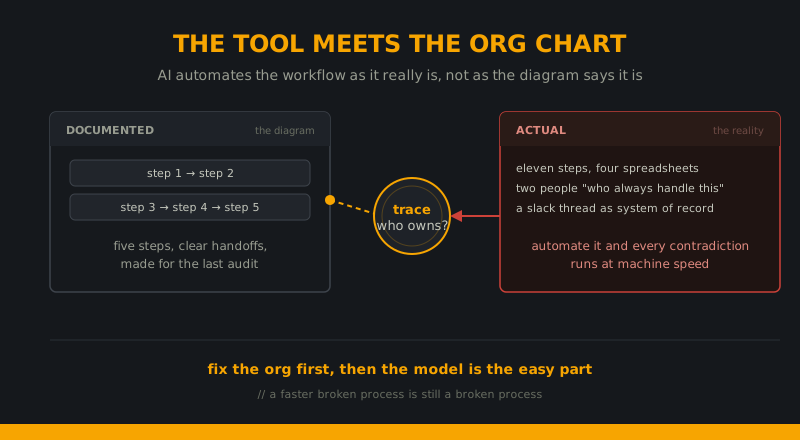
Ask a team to describe their process for, say, responding to enterprise leads, and you will get a clean version. Five steps, clear handoffs, a diagram someone made for the last audit. Then watch the actual work happen. The real process is eleven steps, four spreadsheets, two people who "always handle this part" and are on vacation, and a Slack thread that functions as the system of record.
This gap between the diagram and the reality exists in every organization, and it was survivable when humans did the work. Humans improvise. A person in the middle of a broken workflow absorbs its contradictions without complaint, patches them with judgment, and the org limps along calling it competence.
AI does not improvise around broken workflows. It automates exactly what it is given. Point a model at the real process and it will faithfully reproduce every contradiction, every shadow spreadsheet, every informal handoff, at machine speed and with machine consistency. The failures that follow get blamed on the model. They are the workflow, finally made visible.
This is why the pilot to production gap is so brutal. The pilot worked because a small team with high context hand held it. Production fails because at scale the tool meets the real org chart, and the org chart was never designed for anything to flow through it cleanly.
Why reorganization keeps beating automation
There is a hard rule worth writing on a whiteboard. Automating a broken process gives you a faster broken process. The cost of the mess scales with the throughput.
The teams that succeed with AI almost always do something unglamorous first. Before they pick a vendor, they trace the workflow to its root. Who actually decides here? What actually triggers this step? Which of these approvals exists because of a regulation, and which exists because of an incident in 2019 that nobody remembers? The tracing is organizational work, not technical work.
What they usually find is that a meaningful fraction of the workflow should not exist at all. Approvals that guard against risks that no longer apply. Reports generated for a stakeholder who left the company two restructurings ago. Duplicate data entry caused by two systems that were supposed to be merged in a migration that quietly died. You cannot automate your way out of these. You can only delete them, and deleting them is a decision about power and ownership, which is to say an org chart decision.
The uncomfortable implication is that the highest ROI AI initiative at many companies is not an AI initiative. It is the process surgery that makes AI possible. The model is the easy part. The hard part is getting two vice presidents to agree who owns a decision.
The three org chart failures
When AI programs fail for organizational reasons, the failure usually takes one of three shapes.
The orphaned pilot. A team builds something that works, and then nobody owns it. The pilot lived inside one team's budget and one manager's initiative. When the pilot ends, the tool needs a home: a budget line, an on call rotation, someone accountable when it is wrong. Most org charts have no slot for "the thing that half of the company now depends on." So it stalls at ninety percent adoption and the postmortem calls it a change management problem.
The boundary violation. AI tools, by their nature, cross departmental lines. A support copilot touches the knowledge base that marketing owns, the pricing data that finance owns, and the ticket queue that support owns. The tool is fine. But every one of those owners has veto power over their piece, and no single owner of the whole. Programs die in the seams between teams, not because anyone objects, but because alignment requires a meeting that nobody has the authority to call.
The incentive mismatch. If support agents are measured on tickets closed and the AI tool reduces ticket volume, the tool has just reduced the department's headcount justification. Nobody says this out loud. Instead the tool quietly receives bad data, empty training material, and zero champion energy, and eighteen months later the review says adoption was low. People do not sabotage what they say. They sabotage what they are measured against.
None of these are technology problems. All three are solved by drawing the chart differently: naming a single accountable owner, funding the tool as infrastructure rather than as a pilot, and realigning the metrics before the tool arrives.
A trace, not a transformation
The word "transformation" is part of the problem. It implies a wave that washes over the whole organization at once. What actually works looks more like the trace method we use for products. Pick one workflow, follow it end to end in the real world, not the documented world, find the root cause of its friction, fix the organization first, and only then decide whether a model makes the remaining work faster.
Teams that work this way end up with smaller AI footprints than their transformation decks promised, and far more working software. They automate three steps instead of eleven, because they discovered that eight of the steps were compensation for organizational debt. Their adoption numbers climb because the tools arrive inside processes that already make sense to the people using them.
The lesson generalizes. Every tool you have ever adopted, the CRM, the ticketing system, the data warehouse, succeeded or failed for the same reason. The tool met the org chart, and one of them had to give. AI is not exempt. It is just the first technology unforgiving enough to make the pattern impossible to ignore.
Your AI strategy is your org chart. Everything else is procurement.
ROOT is a technology studio building products from first principles — tracing problems to their root cause and fixing the system, not the symptom.