
DIFFICULTY
HARD
IMPACT
HIGH
Protect victims before the damage is done, without ever holding what endangers them
Privacy First Abuse Response
- BY
- ROOT TEAM
- CREATED
- AUGUST 28, 2026
- UPDATED
- AUGUST 28, 2026
ROOT CAUSE
Current anti abuse infrastructure only activates after content is published, leaving victims unprotected during the threat and coercion phase where most harm actually occurs. Systems that collect intimate images for evidence or blocking create catastrophic single points of failure.
A system architecture that activates on the threat itself, not publication, and proves through its own constraints that it cannot become the next breach.
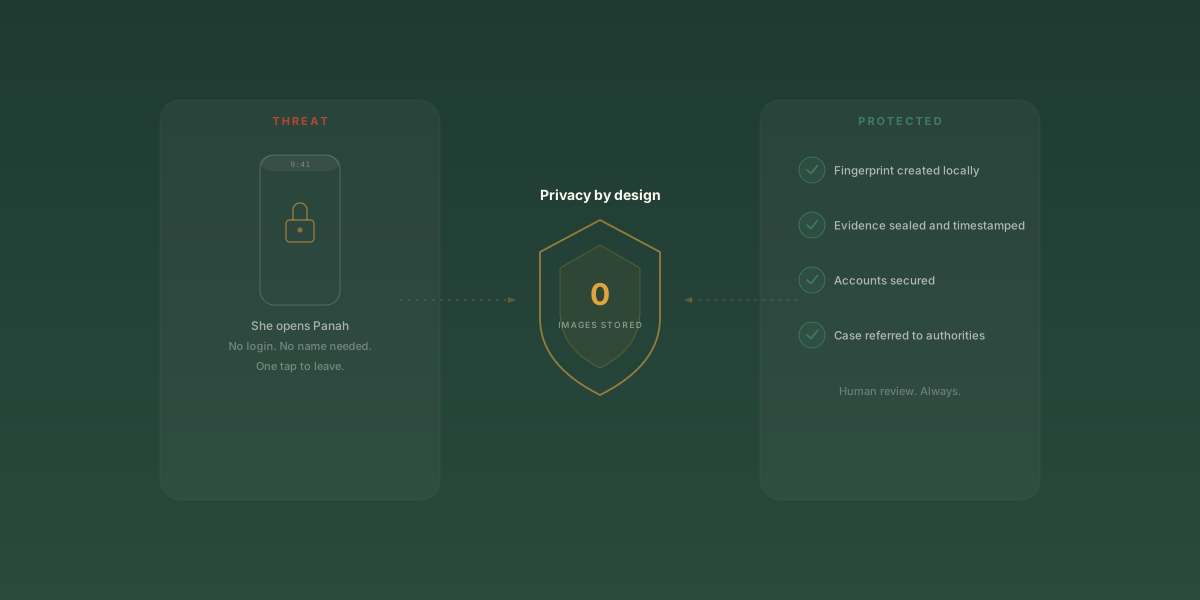
The standard approach to image based abuse is built around publication. A victim reports after content appears. The system responds with takedown, evidence collection, sometimes prosecution. The entire infrastructure assumes you need to see the image to do your job.
Panah begins from the opposite premise. The system should be designed so that it physically cannot become the next breach. The image never enters it. Not because of a policy promise, but because the architecture refuses it.
What the idea attacks
The root problem is not technical. It is structural. Current systems leave a gap between the moment a threat arrives and the moment content is published. During that gap, the victim is alone. She cannot go to the police because nothing has happened yet. She cannot report to a platform because the content is not public. She cannot seek legal help because there is no evidence of a crime in progress.
Meanwhile, the systems that could help her all require the one thing she cannot afford to give. To get a takedown, you need the image on a platform. To preserve evidence, you often need to upload it somewhere. To prove abuse, you need to show it to someone. Every pathway to protection asks her to hand over the material that endangers her.
In an honour based context, this is not an inconvenience. It is a death sentence. A database linking identities to intimate images, held by any institution, is a target. And the victim knows it.
How it works
The system activates when a credible threat is reported. Not when an image is published. The victim opens the app, receives immediate safety guidance, and begins the process. No login is required to start. A leave quickly button handles the case where she is not alone.
On her device, a secure fingerprint of the image is created locally. The picture never leaves the phone. Only the hash is shared, so platforms can block matches if the image later appears. The threatening messages, the sender's identity, and the coercion evidence are sealed into an encrypted, timestamped record.
A transparent risk engine evaluates visible factors. A deadline. Repeated contact. Financial demands. Knowledge of the victim's family. Threats of violence. The model does not decide. It surfaces information for a human reviewer. Cases involving minors automatically route to safeguarding. Violence threats force human review. High risk cases never proceed on automation alone.
The system maintains a tamper evident audit trail. Every access is logged. Independent oversight can verify what was collected, who reviewed it, and that the image was never part of the record.
Why this is hard
The difficulty is not building the software. The encrypted vault, the audit ledger, the risk engine, the referral packet generator, these are implementable. The hard part is the constraint itself.
Every integration point wants the image. Platform takedown requires it. Blocking networks need it for matching. Legal proceedings want it as evidence. The system must resist all of this while still being useful enough that victims trust it and institutions adopt it.
The solution is architectural honesty. The system states what it cannot do and provides honest guidance for what it can. It guides victims to official blocking services rather than pretending to submit on their behalf. It prepares structured referral packets without image content. It makes the limitations visible and trustworthy rather than hiding them behind claims of capability.
What success looks like
The metrics that matter are not complaint counts. A trustworthy system may raise reporting precisely because more women feel safe enough to come forward. Success looks like reduced time from threat to protective action. Fewer cases where publication occurs because intervention happened earlier. Higher rates of escalation for high risk cases. And critically, zero revictimization caused by the system itself.
The honest cost picture is that the software is the inexpensive part. What makes this credible and expensive is trained human reviewers, forensic capacity, and sustained trust. Budget and phasing should follow that reality, not a software timeline.