
Reactive Abuse Infrastructure
- IDENTIFIED
- AUGUST 28, 2026
Anti abuse systems worldwide only activate after content is published, leaving victims unprotected during the threat and coercion phase where most of the actual harm occurs.
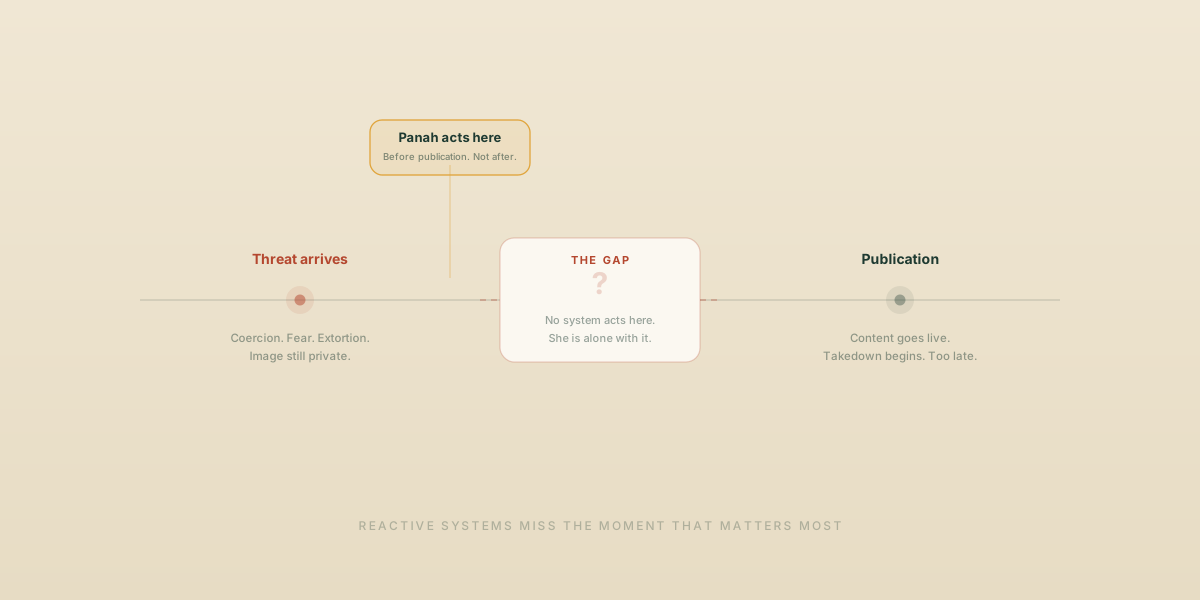
The global standard response to image based abuse begins at publication. A victim reports after content appears online. Institutions respond with takedown, investigation, sometimes prosecution. The entire infrastructure is oriented around the moment the image goes public.
This is backwards. The harm does not begin at publication. It begins at the threat.
The gap that does the damage
The moment someone says, "Do what I say, or I publish," the victim is already experiencing the damage. Coercion, fear, extortion, isolation. These are not precursors to harm. They are harm. And during this phase, no existing system is designed to help her.
She cannot go to the police because nothing has been published. She cannot report to a platform because the content is not yet public. She cannot get a legal order because there is no documented abuse in progress. Every institutional pathway requires the harm to have already occurred.
In an honour based context, this gap is lethal. The threat to send an image to family or community members carries the same weight as the act itself. A woman does not need the image to be published to lose her safety, her autonomy, or her life. But the systems designed to protect her wait for exactly that.
Why existing systems cannot close the gap
The structural problem is that anti abuse infrastructure is built around evidence collection, and evidence collection assumes the harm has already happened. Takedown systems need the content to exist on a platform. Legal proceedings need documented publication. Blocking networks need the image to create a hash.
Every pathway to protection asks the victim to give up the material that endangers her. To report, she must share the image. To preserve evidence, she must store it somewhere. To prove abuse, she must show it to someone. The systems designed to help her all require her to increase her own exposure.
This creates a rational fear of the systems themselves. Victims reasonably ask: who holds this? How is it stored? What happens if you are breached? In a context where honour killings follow exposure, these are not hypothetical questions. They are survival questions.
The compounding effect
The gap feeds itself. Because victims do not report during the threat phase, institutions have no data on the prevalence of coercion. Without data, there is no mandate to build proactive systems. Without proactive systems, victims continue to suffer in the gap. The absence of reporting is interpreted as the absence of harm.
When publication finally occurs and a report is filed, the evidence is scattered, the timeline is unclear, and the victim has already endured the worst of it alone. The system that finally activates is working with damaged evidence and a traumatized person. The investigation is uphill from the start.
Meanwhile, the institution that collected the intimate image as evidence is now itself a risk. The material exists in a database. People have access. Systems can be breached. The protective institution becomes another vector for revictimization.
What would need to change
Closing this gap requires a system that activates on the threat, not the publication. It must protect without collecting the endangered material. It must provide immediate safety guidance, evidence preservation, and institutional routing during the phase when no existing system operates.
The architecture must prove, through its own constraints, that it cannot become the next breach. The image must never be stored. Not as a policy promise, but as a technical impossibility. The system must be designed so that a breach would reveal threat correspondence and sender identities, never the material being weaponized.
This requires institutional courage. The system that acts before publication will generate reports that look like speculation until the threat materializes. It will require human reviewers trained to assess credibility. It will require legal frameworks that recognize coercion as harm, not just publication. And it will require a fundamental shift in how success is measured, from complaints filed to harm avoided.