
DIFFICULTY
HARD
IMPACT
HIGH
Find the real reason an AI agent failed
Agent Root Cause Intelligence
- BY
- ROOT TEAM
- CREATED
- AUGUST 27, 2026
- UPDATED
- AUGUST 27, 2026
ROOT CAUSE
Observability platforms capture what an agent did, but the decision lives inside a neural network. Teams cannot find which context item or instruction caused a wrong plan, so they replay sessions by hand and guess.
A trace tool that walks an AI agent session backwards to find the cause of the failure instead of just showing you the logs.
The debugging problem nobody solved
When a normal service fails, you reproduce it. Send the same request, watch the same wrong response, and debug the code. Agents break that whole loop. Send the same prompt twice and the agent takes a completely different path each time. There is no repeatable reproduction, so debugging becomes guesswork.
Today a team watching a failing agent has two options. Read thousands of raw log lines and tediously narrate what happened, or replay the whole session by hand and hope the failure shows up again. Both are slow. Neither tells you which specific instruction, which earlier tool result, or which summarized memory caused the wrong plan.
Observability tools tell you what the agent did. That is the easy half. Nobody has cracked the why. That is the hard half, and it is exactly where a root cause discipline belongs.
Why the what is not enough
A tracing platform will happily show you that an agent called a search tool, wrote a file, and then stopped. That trace answers what. It never answers why the agent called search at that moment, why it trusted one source over another, or which detail in a forty thousand token context steered the plan off course.
The decision lives in a neural network. You cannot step through it like code. But you can capture everything the agent saw and did, then trace the failed output back to the specific context that pushed it into the wrong behavior. That is a solvable engineering problem, and current tools skip it.
What a root cause trace needs
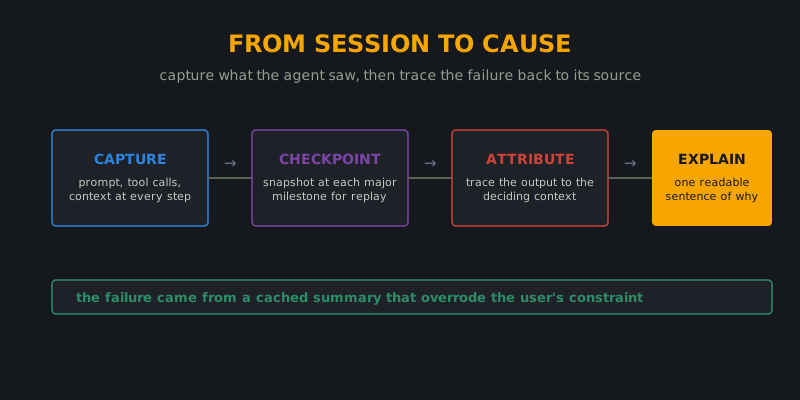
An agent session is a chain. The failure at step forty came from something at step three. To find it, the trace needs to walk backwards:
- Capture everything: the prompt, every tool call, and the context at each step, not just the final failure.
- Take snapshots: record what the agent knew and read at every decision point, because context changes everything downstream.
- Attribute causality: trace the wrong output back to the instruction, tool result, or context drift that produced it.
- Explain in plain language: reduce the finding to one readable sentence, such as this instruction came from an old cached summary and overrode the user's constraint.
Removing the non determinism
Replay is the key. If an agent fails at turn twenty after four hours of work, nobody wants to lose that run. Save checkpoints at each major milestone so you can restore and replay from any point with a tweaked instruction or a corrected tool result. Branch comparison then shows what happened on the path that worked versus the path that failed. The difference reveals the cause.
The early warning signals
Often the failure is not at the end. It builds up first. Context drift, where an instruction stated at turn one gets diluted or contradicted by turn thirty. Runaway cost, where an agent replans in a loop. Unexpected tool calls. Each of these is a symptom pointing to a source, and each is catchable before the session ends in tears.
Why this fits a first principles studio
The whole market built dashboards and then stopped. They show what an agent did and call it observability. A root cause tool starts from the actual problem, which is that engineers cannot find why an agent failed, and builds back up from there. That is the difference between counting logs and delivering understanding.
Current status
Early research phase. We are evaluating session capture formats, causal attribution approaches, and replay tooling. The goal is a trace that answers why in the same way our framework turns a ticket into a cause.