
The Most Important Code in Your Repo Isn't Code
- BY
- ROOT TEAM
- PUBLISHED
- OCTOBER 13, 2026
- READING TIME
- 8 MIN READ
Every serious repository now carries a directory written not for the compiler and not for the next human, but for the model about to touch the source. It is quietly the highest-stakes artifact you ship, and most teams are filling it with API maps. Here is what belongs there instead.
Open any serious repository in 2026 and you will find a directory that did not exist two years ago. A folder of instructions written not for the compiler and not for the next human, but for the model that is about to touch the code. Skill files, agent definitions, review conventions, incident playbooks, all sitting in version control next to the source they govern.
Here is the claim we would defend: this directory is the most important code in your repository. Not the payment path, not the migration framework, not the clever caching layer. The instructions, because they are the only artifact that executes on every single commit, and because whatever they contain gets multiplied by every agent that reads them. Most teams are filling them with the wrong half of what belongs there.
Why it outranks everything around it
Importance is not the same as difficulty. The payment path is harder to write than a skill file. But importance is about leverage, and leverage is about how often something runs and how much it touches when it does.
Your deploy script runs when you ship. Your database schema touches every feature slowly, through migration. Your agent directory executes on every commit, every refactor, every late night fix, and it shapes not just what the agent does but what it declines to do. It is the only artifact in the repository with a multiplier on it. A wrong line in a feature breaks a feature. A wrong line in the agent directory breaks every feature the agent touches afterward, quietly, in the direction of whatever the line encodes.
And there is a second reason it outranks the code around it. Every other artifact gets executed by something that checks its work. The compiler refuses bad syntax, the test suite fails on bad behavior. The agent directory executes inside a system that follows instructions confidently and never fails a build for following a bad one.
The library changed what it packages
To see what should go in this directory, it helps to see what the industry is already doing with it. The standard library used to have a clear meaning: packaged capability. Parsing, HTTP, dates, the solved problems your language handed you. Every decade it absorbed more. Package managers turned the ecosystem into a library. Frameworks packaged architecture.
Agent skills are the next absorption, and the shift is easy to miss. A skill file does not package functions. It packages judgment. How this repository reviews a diff. When a change counts as load bearing. What the team does first when production breaks, and what it refuses to do under pressure. The teams getting real leverage from coding agents in 2026 are not the ones with the best prompts in a chat window. They are the ones whose agent reads the same process document a new hire would, and cannot skip it.
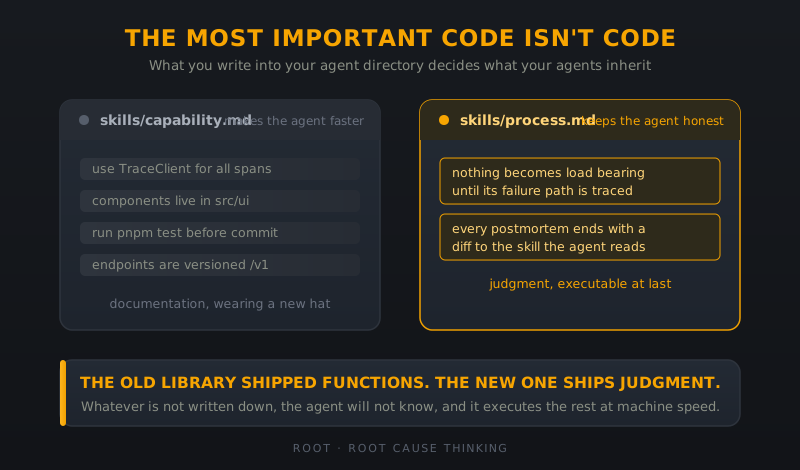
Most teams write capability. The valuable half is process.
Look at what most teams write in their agent configuration today and a pattern emerges: it is almost all capability. How to call the internal API. Which components exist. What the naming conventions are. Useful, but it is documentation wearing a new hat, and documentation was already a solved problem.
The skills that change outcomes are process. Consider the difference between two lines you could write into a skill file.
Capability: "Use the TraceClient from @rootshq/sdk for all spans."
Process:    "Nothing becomes load bearing until its failure path
             has been traced to a cause. Trace before you depend."
The first line makes the agent faster. The second line makes the agent safer, and only one of them survives contact with a deadline. A well stocked capability library with no process means every agent interaction inherits the habits of whichever model happens to be running: confident, fast, and indifferent to what it does not understand. The team's actual judgment, the thing that took years of incidents to learn, lives nowhere the agent can see.
The root cause is an absence, not a tool
Here is the part that should sting a little. Teams complain that agents take shortcuts, that they fix symptoms, that they ship plausible code nobody traced. Then you open their agent configuration and find conventions and API maps, and not a single line about how the team reasons. The agent is not ignoring the process. The process was never written down.
Trace it the way we trace everything.
Symptom:   the agent fixes the error and leaves the cause in place
     why
Surface:   the agent has no access to the team's reasoning rules
     why
Layer 2:   the rules exist, but only in heads, calls, and onboarding
     why
Origin:   the repository never required process to be written to
           survive, because until agents showed up, humans could
           absorb it by proximity
That is the origin, and notice what it means. This is not a problem the agents caused. It is an absence they made expensive. For twenty years, unwritten process was a hidden tax paid slowly through onboarding and repeated mistakes. Agents turned it into a multiplier: whatever is not written down, they will not know, and they will execute at machine speed whatever is. A team's unwritten wisdom used to degrade gracefully. Now it is bypassed on every single commit.
What we actually do about it
We run our studio on this, so the practice below is not theory. It fits in four rules, and it works whether your agent directory has three files or thirty.
One. Every skill carries a why. A skill that says what to do without saying why is a rule waiting to be misapplied. When the reasoning is in the file, the agent can generalize it to the situation the rule never anticipated, which is the only situation that matters. We write skills as traces: here is the failure we saw, here is the cause we found, here is the rule that came out of it.
Two. Skills are reviewed like code. A bad skill ships to every future interaction, so a change to the agent directory gets the same review as a change to a payment path. The question in review is not whether the instruction is clear. It is whether the judgment behind it is one the team would defend in an incident retrospective.
Three. Every postmortem ends with a diff. When we trace a failure to its cause, we ask one more question: which instruction would have prevented this? If the answer exists, the fix is not a memo. It is a line added to the skill the agent already reads. The process document compounds the way code does, one learned lesson per incident, forever in version control.
Four. Prune on a schedule. Stale skills are debt with worse interest than stale code, because nothing fails a build when a skill is wrong. Every quarter we delete anything that no longer reflects how we work. An agent following yesterday's process confidently is more dangerous than one with no process at all, because at least the second one gets questioned.
The repo you are really shipping
There is a way to see all of this that we give every team we work with. Your repository has always been two artifacts. One is the system that runs in production. The other is the argument for why the system is built the way it is, and until recently that second artifact lived in the most unreliable storage available: people. Agent directories are that artifact finally getting a real home, and treating them as configuration clutter misses what they are. They are the first version of your engineering judgment that a machine can execute.
So the test for a skill file is not whether it is clever. It is this: if you handed your whole agent directory to a strong engineer who had never met the team, would they make decisions the way you do? If yes, you have written your process down, and every agent you adopt inherits it. If no, you have written an API map, and every agent you adopt inherits nothing.
Try it on your own repo
Read your agent configuration like a stranger and count the lines that say how things work, then count the lines that say how you think. Most repos score ten to zero on that count, and the fix is not a rewrite. It is one line: take the most expensive mistake your team made this year, the one an agent would happily repeat tomorrow, and write down the rule that would have stopped it.
Do that once a quarter and in two years your agent directory will be the thing new hires read first, because it will finally contain what used to live only in your head.
If you would rather have us trace where your process is unwritten, that is our daily work.
Related reading: Vibe Coding Debt Is the New Technical Debt covers what happens when output ships without understanding. Traces Are Not Explanations shows why recording what happened is not the same as recording why.
ROOT is a technology studio building products from first principles — tracing problems to their root cause and fixing the system, not the symptom.