
Temporal Technologies: Why Durable Execution Changed How We Think About Failure
- BY
- ROOT TEAM
- PUBLISHED
- AUGUST 31, 2026
- READING TIME
- 5 MIN READ
Most backend code treats failure as an exception. Temporal treats it as the default. This is a plain language look at durable execution and why it quietly rewrote the rules of building reliable systems.
Every backend engineer has written the same function at some point. It charges a card, reserves inventory, sends a confirmation email, and updates a database. On a good day it works. On a real day the process dies halfway through, the card is charged, the email never sends, and nobody knows what state the order is in.
The industry spent two decades patching this problem with queues, retries, idempotency keys, saga patterns, and outbox tables. Each one helps. Each one is also more code you have to write, test, and reason about at three in the morning.
Temporal technologies take a different position. Instead of helping you recover from failure, they make your code unable to lose its place in the first place.
What durable execution actually means
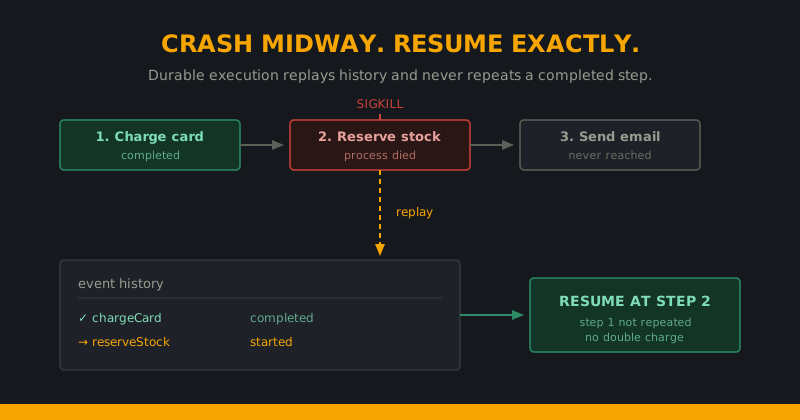
The idea is simple to state. When your workflow function runs, Temporal records every step it completes. If the process crashes, the workflow does not restart from the beginning. It replays the recorded history, skips the steps that already finished, and resumes exactly where it stopped.
export async function placeOrder(order: Order) {
  await activities.chargeCard(order);
  await activities.reserveInventory(order);
  await activities.sendConfirmation(order);
}
That looks like ordinary code, and that is the point. There is no queue wiring, no retry table, no state machine to maintain. If chargeCard succeeds and the server loses power before reserveInventory runs, Temporal brings the workflow back and runs reserveInventory next. The sequence completes even though the machine it started on no longer exists.
The industry calls this durable execution. It means the progress of your program is a fact stored outside your program.
Why this is a bigger deal than it sounds
Most reliability work is really bookkeeping work. Teams build systems to answer questions like:
- Did this step already happen?
- What happens if it happened twice?
- Where was this order when the deploy killed it?
- How do we retry without making things worse?
Durable execution answers all four by construction. The event history is the source of truth, so "did this happen" is a query, not an investigation. Retries are configured once per activity instead of hand rolled per code path. And if something goes wrong, you can read the full execution history of any workflow like a log of exactly what it did and when.
At ROOT this maps directly to how we think about root causes. When every step is recorded, debugging stops being guesswork. You are not reconstructing what probably happened. You are reading what definitely happened.
The trade nobody mentions in the demo
Temporal is not magic, and honest engineering writing should say so.
First, your workflow code has to be deterministic. The same inputs must produce the same decisions, because replay depends on it. Random values, current time, and direct network calls belong in activities, not in the workflow body. Teams that miss this rule learn it through confusing replay errors.
Second, you are adopting an infrastructure component with real operational weight. The Temporal server, its database, and your workers all need to run somewhere and be monitored. For a team of three, that cost is real.
Third, it changes how you model problems. Long running processes become workflows, side effects become activities, and versioning old workflows while new ones deploy becomes its own discipline. That mental shift is worth it, but it is not free.
When it earns its keep
We reach for durable execution when a process has any of these properties:
- It spans multiple services or waits on slow external systems.
- It must not lose work, such as payments, signups, or data migrations.
- It runs long enough that deploys and crashes are guaranteed mid flight.
- Someone will eventually ask exactly what happened to a specific instance.
A two second request handler does not need it. A customer onboarding flow that calls four third party APIs, waits up to three days for email verification, and must never double bill absolutely does.
The deeper lesson
You can take the idea without taking the tool. The reason temporal technologies work is that they stop treating failure as exceptional. They assume processes die, networks partition, and deploys interrupt everything, then they build correctness on top of those assumptions.
That assumption first mindset is the same one behind every reliable system we have ever shipped. Ask what will definitely go wrong, design for it up front, and the three in the morning pages mostly stop arriving.
Reliability is not what you add after the system breaks. It is what you decide about failure before writing the first line.
If you want to go deeper, the official site is at temporal.io, and the documentation lives at docs.temporal.io.